
Reverse osmosis skid systems are compact, modular water treatment units pre-assembled on a single frame to deliver high-quality purified water efficiently. For water treatment professionals, plant operators, engineers, and decision-makers in industries such as food and beverage, pharmaceuticals, electronics manufacturing, and municipal water treatment, understanding how these packaged systems are designed, operated, and maintained is key to improving performance, scaling capacity, and controlling operating costs.
This article explains what packaged reverse osmosis skids are, how they function, and the primary components that make them work. It will also provide practical guidance on pretreatment methods, system instrumentation and control, design considerations, sizing and applications, troubleshooting, post-treatment options, and lifecycle cost factors.
Key Takeaways
- Reverse osmosis skid systems offer a streamlined, ready-to-install solution for water purification needs.
- High-pressure pumps and membrane vessels are central to achieving effective contaminant removal.
- Pretreatment strategies are vital in minimizing operational issues and protecting membranes.
- Modular skid designs provide flexibility for scaling and adapting to evolving water treatment demands.
- Post-treatment options ensure water quality meets specific industrial or municipal standards.
- Efficient operation balances high recovery rates with the prevention of membrane fouling and scaling.
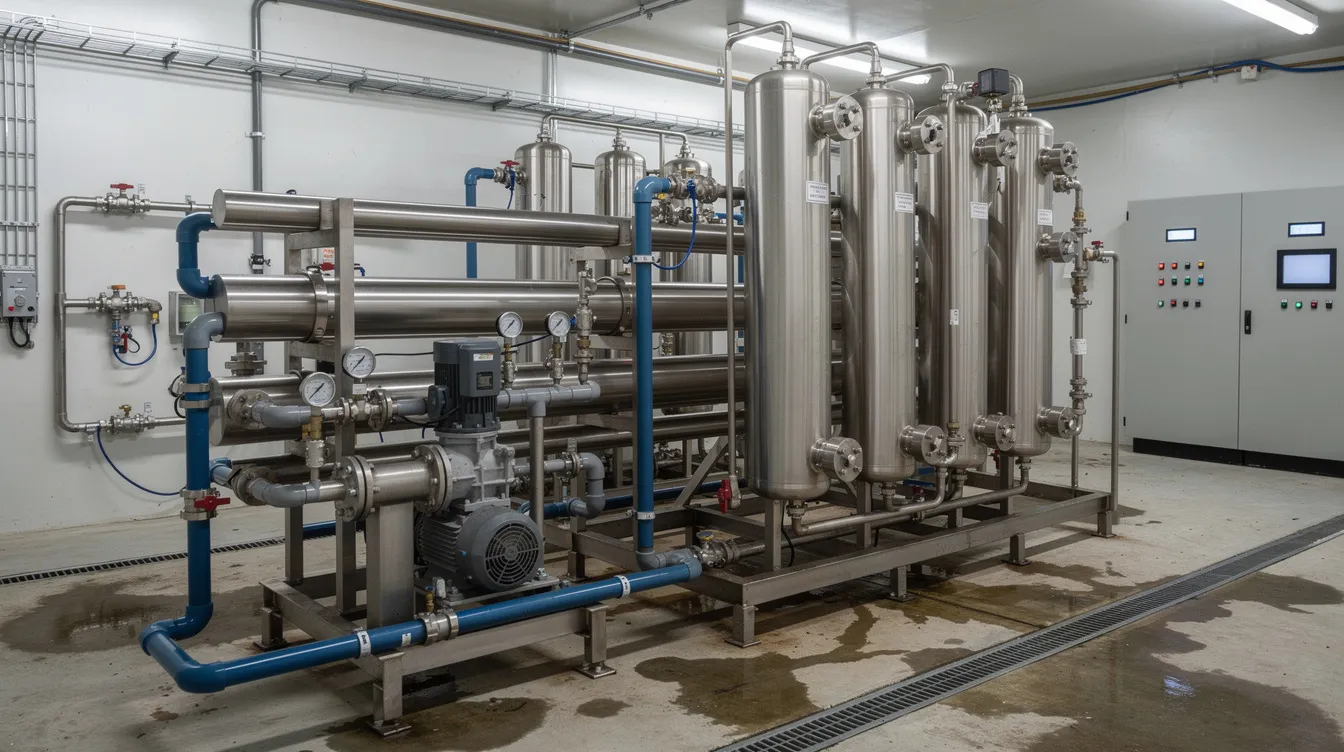
What Is a Packaged Reverse Osmosis Skid?
A packaged reverse osmosis skid is a pre-assembled water treatment system mounted on a single frame or skid. It integrates all essential components into a complete reverse osmosis system, with a layout that supports proper functioning of pumps, valves, and instrumentation. This design simplifies installation by reducing field assembly requirements and accelerates startup by providing a ready-to-operate system. Good system design also helps maintain stable output and supports efficient operation as plant demand changes. The compact footprint and pre-wired controls facilitate faster integration with existing plant utilities, minimizing installation time and errors.
Primary Components of Osmosis Skids: High Pressure Pump And Membrane Vessels
The core components of an RO skid include the high-pressure pump, one of the skid’s critical high pressure pumps, and membrane vessels. The RO unit relies on this pump to create the high operating pressure needed for the RO process by forcing feed water through the membranes. Membrane vessels in reverse osmosis RO systems house the RO membrane, the core filtration element in reverse osmosis technology. This semi permeable membrane removes dissolved salts and other water contaminants during the filtration process. Membrane performance is typically measured by metrics such as salt rejection rate, permeate flow, and pressure drop across the membranes.
How Osmosis Systems Work
Reverse osmosis systems operate by pushing feed water across semi-permeable membranes under high pressure, using cross-flow filtration to limit buildup on the membrane surface. As water passes through the membranes, purified water called permeate is collected, while concentrated water containing rejected contaminants is discharged as the reject stream. The applied pressure must exceed the natural osmotic pressure to enable water to pass through the membranes effectively, ensuring high purification efficiency. This purification process removes harmful contaminants, and the membrane openings are about 0.0001 microns.
Pretreatment And Ion Exchange To Prevent Membrane Fouling
Proper pretreatment is critical to prevent membrane fouling and scaling. Common pretreatment steps include filtration through a Multi-Media Filter to remove suspended solids, including particulates down to 15-20 microns, and chemical dosing to control scaling and microbial growth. Antiscalants increase solubility limits of inorganic compounds in feed water. Sodium bisulfite is commonly used to remove residual chlorine before the RO system. Ion exchange processes, with a water softener as a common pretreatment option, help reduce hardness ions that contribute to scaling while supporting consistent water quality and stable operation. Effective pretreatment extends membrane life and maintains system efficiency. Monitoring parameters like turbidity, pressure differentials, and water chemistry helps detect early signs of fouling.
Maintaining Optimal Performance During Continuous Operation
Consistent monitoring and preventive maintenance are essential for maintaining system health during continuous RO operation. Regularly scheduled cleaning-in-place (CIP) procedures, typically performed one to four times per year depending on feed water quality, along with routine monitoring, help with improving efficiency and reducing maintenance costs. Operational efficiency can be improved by optimizing operating pressures and recovery rate. Many systems operate in the 50% to 85% range, and flux can range from 8-30 GFD depending on the water source. Keeping an inventory of critical spare parts, such as membranes and pumps, minimizes downtime in case of component failure. Together, these practices support stable operation and consistent water quality over time.
Instrumentation, Control, And Early Detection Strategies
Installing key sensors enhances operational control and early problem detection. Conductivity sensors on feed and permeate lines monitor water quality and system efficiency. Pressure gauges on feed and concentrate lines help identify pressure fluctuations indicating fouling or flow restrictions that can affect proper functioning. Integration with programmable logic controllers (PLCs) and human-machine interfaces (HMIs) allows real-time monitoring, alarm management, and data logging at recommended intervals to ensure timely responses to system changes. This monitoring data supports system health and more efficient operation of the purification process.
Sensors For Early Detection
Critical sensors include:
- Conductivity meters on the feed water line to detect feed water quality fluctuations
- Conductivity sensors on the permeate line to ensure product water purity
- Pressure sensors on feed and concentrate lines to monitor for fouling or membrane damage
Design Considerations For Packaged Reverse Osmosis Skids
Designing an RO skid involves good system design to support stable output, continuous operation, and future expansion in reverse osmosis plants. Modular designs enable easy capacity expansion by adding additional skid units. Reverse osmosis skids can be configured for feed water TDS levels from 1000 ppm to 45000 ppm, including brackish water up to 15,000 ppm. Balancing recovery rates with fouling risk is crucial. Operating at higher recovery improves water yield but can increase scaling potential, so numerous factors influence the design. These also influence feed water quality, pretreatment effectiveness, and water reuse and recycling goals for sustainability.
Applications And Sizing For Osmosis Skids
RO skids serve diverse industries for many industrial applications and industrial processes, such as: food and beverage, pharmaceuticals, electronics manufacturing, semiconductor manufacturing processes, and municipal water treatment where high quality water is essential. Proper sizing depends on factors like required flow rates, feed water quality, and the level of consistent water quality needed. This helps determine the right water treatment technologies. For larger systems, incorporating energy recovery devices can reduce energy consumption and operational costs.
Troubleshooting: Membrane Fouling, Pressure Issues, And Pump Failures
Rising differential pressure across membranes often indicates fouling and necessitates cleaning. High-pressure pump issues such as cavitation can reduce flow rates and damage membranes. Pressure relief valves protect the RO unit from damaging backpressure during startup or upset conditions. Increased permeate conductivity suggests membrane degradation or pretreatment failure. Pressure gauges also help verify system health when troubleshooting fouling, flow restrictions, or membrane damage. Regular inspection and timely membrane replacement based on performance criteria help maintain system reliability.
Post-Treatment Options: Ion Exchange And Polishing For Pure Water
Post-treatment processes like ion exchange polishing remove residual dissolved ions when industrial processes require high quality water beyond standard RO permeate to achieve ultra-pure water standards. Other common options include ultraviolet (UV) disinfection and activated carbon filtration to eliminate microbial contaminants and organic compounds. Downstream handling may also include storage tanks to maintain water levels and support continuous operation before final use. Final water quality testing ensures compliance with application-specific standards.
Closing Insights on RO Skid Performance and Maintenance
In summary, packaged reverse osmosis skid systems provide a reliable, efficient, and scalable solution for producing high-quality purified water. Understanding their components, operation, and maintenance requirements enables operators to maximize system performance and longevity across various industrial and commercial applications. For expert guidance and tailored water treatment solutions, contact our team today to discuss how we can support your facility’s water quality needs and optimize your treatment processes.
Frequently Asked Questions (FAQs)
What is a reverse osmosis skid system?
A reverse osmosis skid system is a compact, modular water treatment unit pre-assembled on a single frame. It integrates all essential components, such as high-pressure pumps and membrane vessels, to efficiently produce purified water by removing dissolved salts and contaminants.
How does a reverse osmosis skid overcome osmotic pressure?
The system uses a high-pressure pump to apply pressure greater than the natural osmotic pressure, forcing feed water through semi-permeable reverse osmosis membranes. This process separates contaminants from the purified permeate water.
What role does pretreatment play in RO skid operation?
Pretreatment, including multi-media filtration, carbon filters, and chemical dosing like antiscalants and sodium bisulfite, is essential to prevent membrane fouling and scaling. Proper pretreatment ensures reliable water quality and extends membrane life.
What industries commonly use reverse osmosis skid systems?
RO skids are widely used in industries such as beverage production, pharmaceuticals, electronics manufacturing, semiconductor fabrication, and municipal water treatment where consistent high-quality water is critical.
How energy efficient are reverse osmosis skid systems?
Modern RO skids incorporate energy-efficient reverse osmosis membranes and may include energy recovery devices to reduce power consumption, improving overall energy efficiency during continuous operation.
What maintenance is required for RO skid systems?
Routine maintenance involves monitoring system pressures, flows, and water quality, performing membrane cleaning 1 to 4 times per year, and timely replacement of membranes and components to prevent fouling and scaling.
Can RO skids be expanded for increased capacity?
Yes, the modular design of reverse osmosis skid systems allows for easy capacity expansion by adding additional skid units, accommodating changing production demands without major redesign.
How do RO skids support sustainable water use?
RO skids enable water reuse and recycling by producing reliable purified water, reducing discharge volumes, and supporting sustainability goals in various industrial and municipal applications.
