
How ion exchange works is that it removes undesirable ions from water by replacing them with more acceptable ones. This exchange occurs through ion exchange resins: small, porous beads made of cross-linked organic polymers with functional groups that facilitate ion exchange reactions. The process is essential for water softening, contaminant removal, and scale prevention in both residential and industrial applications.
Key Takeaways
- Ion exchange is a reversible chemical process that removes undesirable ions from water by exchanging them with more acceptable ions of the same charge.
- The process uses ion exchange resins that selectively bind ions like divalent cations (calcium, magnesium) and other contaminants.
- Water softening is the most common application, replacing hardness ions with sodium ions to prevent scale and improve water quality.
- Ion exchange resins require periodic regeneration using salt or acid/base solutions to restore their ion exchange capacity.
- Challenges include resin fouling, waste management of regeneration brines, and operational costs, but advancements like magnetic and hybrid resins improve efficiency and sustainability.
- Proper resin selection and system design ensure effective contaminant removal while maintaining electrical neutrality and process efficiency.
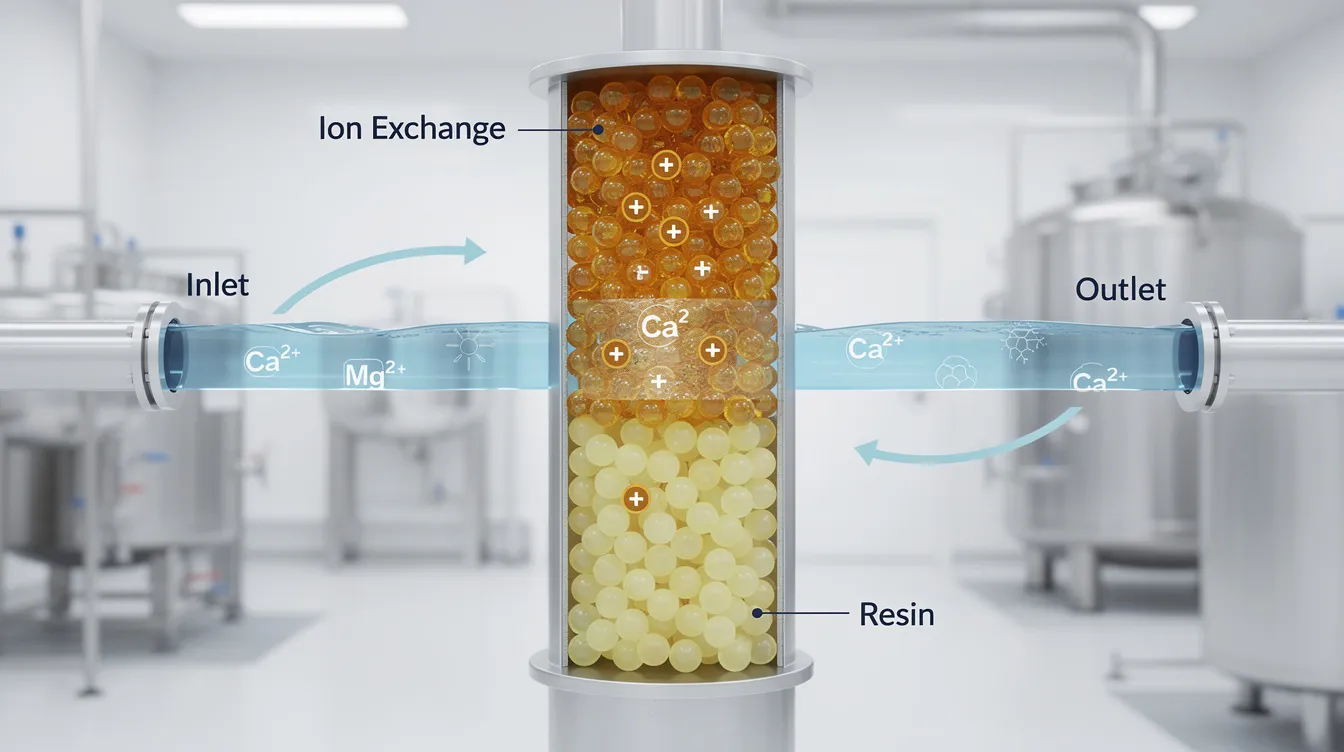
How Does Ion Exchange Work?
- Resin Charging: Ion exchange resin beads are initially charged with sodium ions (Na⁺) in a cation exchange resin. These beads contain fixed negatively charged groups that hold exchangeable ions, and each cation resin site is prepared for the next exchange reaction.
- Ion Exchange: As hard water passes through the resin bed, positively charged ions (cations) like calcium (Ca²⁺) and magnesium (Mg²⁺) are attracted to the negatively charged resin groups. In the water softening process, these hardness ions are the target ions and displace sodium ions, which are released into the water, resulting in softened water.
- Effluent Quality: The effluent water is softened by replacing hardness ions with sodium ions. The resin exchanges ions of the same charge to maintain electrical neutrality. The process occurs between similarly charged ions, driven by electrostatic attraction and ion selectivity.
- Regeneration: Over time, resin becomes saturated with hardness ions and requires regeneration. Water softening is the most common method for treating hard water. Water softeners regenerate using a brine solution of sodium chloride (NaCl), which replaces calcium and magnesium ions with sodium ions and restores resin capacity for reuse.
Ion Exchange Resins and Mechanisms
Ion exchange involves reversible reactions between water and solid resin beads containing fixed ions. The dissolved ions themselves have positive and negative charges: positively charged ions are called cations, while negatively charged ions are anions. Ions diffuse through the resin pores surrounded by water molecules during transfer.
- Cation Exchange Resins: Remove positively charged ions such as calcium, magnesium, and heavy metals. These cation exchangers include strongly acidic resins and the weak acid cation subtype.
- Anion Exchange Resins: Remove negatively charged ions like nitrate, sulfate, chloride, and fluoride. These anion exchangers include strong base resins and the weak base anion subtype used to remove negatively charged contaminants from aqueous solutions.
The process relies on electrostatic forces and the principle of electrical neutrality, ensuring balanced charge exchange. Resin properties like porosity and surface area affect exchange efficiency, while ionic charge and atomic weight influence selectivity. In practice, ion exchange materials treat aqueous solutions by swapping specific ions between the resin and the liquid phase.
Types of Ion Exchange Resins
- Cation Exchange Resins: Contain fixed negatively charged groups (e.g., sulfonate –SO3⁻, carboxylate –COO⁻) and exchange positively charged ions. Common cation exchange resin types include strongly acidic resins and weakly acidic resins for specific uses.
- Anion Exchange Resins: Contain fixed positively charged groups (e.g., quaternary ammonium –NR3⁺) and exchange negatively charged ions. This anion exchange material can be formulated as strong base or weak base media for different contaminants.
- Specialty Resins: Designed for targeted ion removal, such as chelating resins for heavy metals or magnetic ion exchange resin used to reduce natural organic matter in surface water or effluent water.
Selecting the appropriate resin type is critical for effective water treatment.
Ion Exchange Mechanisms and Selectivity
Ion exchange is an exchange reaction in which similarly charged ions are swapped in the same manner to maintain electroneutrality. Selectivity depends on:
- Ionic Charge: Only ions with the same charge as the resin’s fixed ions are exchanged.
- Ion Size and Atomic Weight: Ions with higher atomic weight or smaller hydrated radius generally have greater affinity. Some are strongly attracted to the resin than others, which affects removal of specific ions.
- Polyatomic Ions: Complex ions like sulfate (SO4²⁻) and nitrate (NO3⁻) are effectively removed depending on resin design.
A divalent ion in a high concentration may displace monovalent ions more effectively, depending on selectivity and operating conditions.
This selectivity enables targeted contaminant removal.
Contaminants Removed by Ion Exchange
Ion exchange systems can deliver high removal efficiencies when the resin is matched to the target ions in drinking water treatment.
- Hardness Minerals: Calcium (Ca²⁺) and magnesium (Mg²⁺), preventing scale buildup.
- Other Ions: Dissolved salts, heavy metals (lead, cadmium), arsenic, nitrate, fluoride, radionuclides, and strontium.
- Natural Organic Matter: Magnetic ion exchange resin is used to remove disinfection byproduct precursors from surface water and effluent water.
Chloride ions can serve as exchange ions in some treatment setups for problematic anions.
Benefits of Ion Exchange in Water Softening
Ion exchange is beneficial to water softening for the following reasons:
- Prevents scale formation in pipes and appliances by removing hardness ions; in residential treatment, the water softening process is the standard application of a cation resin.
- Improves water quality for residential and commercial use.
- Enhances detergent efficiency in soft water.
- Offers high removal efficiencies for specific contaminants when the target ions are suitable for ion exchange.
- Systems are versatile, regenerable, and cost-effective over time.
Applications Beyond Water Softening
Outside of water softening, ion exchange also removes:
- Arsenic and Nitrate: Using anion exchangers selected for specific ions based on contaminant chemistry.
- Fluoride: Reduced by strong base anion resins.
- Heavy Metals: Lead, cadmium, mercury, radium removal using cation exchangers for positively charged contaminants; a divalent ion such as radium can sometimes be captured more effectively than a monovalent ion.
- Radionuclides and Strontium: Specialized resins target radioactive ions.
- Natural Organic Matter: Magnetic resins reduce disinfection byproduct precursors.
Ion exchange chromatography is a related separation method used to separate and purify charged substances, though it is distinct from bulk water treatment.
Regeneration and Waste Management
The regeneration process is a critical aspect of ion exchange systems, ensuring that the resin maintains its ion exchange capacity and continues to function effectively over multiple cycles. During regeneration, the resin beads that have become saturated with target ions—such as calcium and magnesium in water softening applications—are flushed with a regenerant solution. For water softeners, this typically involves a concentrated sodium chloride (NaCl) brine solution, which replaces the hardness ions on the resin with sodium ions, restoring the resin’s original state.
Different ion exchange systems may require specific regenerants depending on the type of resin and ions involved. For example, some cation exchange resins may be regenerated using acids like hydrochloric acid (HCl) or sulfuric acid (H₂SO₄), while anion exchange resins commonly use sodium hydroxide (NaOH) for regeneration. The choice of regenerant depends on the resin chemistry and the ions being removed.
Regeneration produces wastewater streams containing high concentrations of displaced ions and regenerant chemicals. These wastewaters require careful management and proper disposal to prevent environmental contamination. The concentrated brine or acid/alkali solutions discharged during regeneration can contain elevated levels of hardness ions, heavy metals, or other contaminants removed from the water. Treatment or controlled disposal methods must comply with local environmental regulations to mitigate potential impacts.
Optimizing the regeneration process is essential for sustainable operation. Efficient regeneration minimizes the volume of chemicals and water used, reduces wastewater production, and extends resin life. Techniques such as regenerant dose control, flow rate optimization, and monitoring resin exhaustion levels help achieve this balance. Proper regeneration scheduling also prevents premature resin fouling and maintains consistent water quality.
Challenges and Limitations
The process runs into some challenges and limitations to consider and watch out for:
- Fouling and Scaling: Suspended solids and mineral deposits reduce resin efficiency, and resin physical properties also affect long-term performance and susceptibility to fouling.
- Selectivity Constraints: Competing ions in the liquid phase may hinder removal of target ions, especially in aqueous solutions with high concentration.
- Operational Costs: Resin replacement and regeneration chemicals add expenses.
- Waste Disposal: Spent regenerants require environmental compliance.
Pre-treatment and maintenance mitigate these issues.
Advanced Ion Exchange Technologies
- Magnetic Ion Exchange Resins: These resins incorporate magnetic particles within the resin matrix, enhancing the removal of natural organic matter (NOM) from water sources. The magnetic properties facilitate easier separation and recovery of the resin during regeneration processes, improving operational efficiency and reducing downtime.
- Hybrid Ion Exchangers: Hybrid exchangers combine the advantages of organic ion exchange resins with inorganic ion exchange materials, such as zeolites or other inorganic frameworks. This combination results in materials with improved mechanical strength, chemical stability, and enhanced selectivity for specific ions. Hybrid exchangers are often more cost-effective and durable, making them suitable for a wide range of industrial water treatment applications.
- Ion Exchange Membranes: These membranes function as selective barriers that allow the passage of either cations or anions while blocking others. Ion exchange membranes are integral components in electrodialysis and specialized desalination technologies, enabling efficient separation of ions under an applied electric field. Their use extends ion exchange applications to processes requiring precise ion removal and recovery, such as brackish water desalination and wastewater treatment.
These innovations expand the versatility and efficiency of ion exchange processes, enabling tailored solutions for complex water treatment challenges and advancing sustainable water management practices.
Environmental and Economic Considerations
Balancing operational efficiency with environmental stewardship is key to maximizing the benefits of ion exchange technology. As such, here are some factors to always keep in mind:
- Cost-Effectiveness: The use of regenerable ion exchange resins significantly reduces the need for frequent resin replacement, lowering operational costs over time.
- Reduced Chemical Use: Compared to chemical precipitation methods, ion exchange generates less sludge and requires fewer chemicals, making it a cleaner treatment option.
- Water Conservation: Advanced resin regeneration techniques optimize regenerant use and minimize water consumption during the regeneration cycle.
- Environmental Impact: Proper management and disposal of regeneration wastewaters are critical to preventing environmental contamination, ensuring compliance with regulations.
- Sustainability Balance: Achieving efficient ion removal while minimizing chemical, water, and waste footprints is essential for sustainable water treatment operations.
Understanding Ion Exchange in Water Treatment
Understanding ion exchange is essential for optimizing water treatment systems. This reversible and versatile process effectively removes a broad range of contaminants, making it a cornerstone of modern water treatment. Despite challenges like fouling and waste management, ongoing advancements in ion exchange materials and methods continue to improve efficiency and sustainability. Mastering these principles ensures effective, adaptable, and environmentally responsible solutions for current and future water quality needs.
For water treatment needs and concerns, contact our team today for expert guidance.
Frequently Asked Questions (FAQs)
What types of ions can ion exchange remove from water?
Ion exchange can remove both positively charged ions (cations) like calcium, magnesium, heavy metals, and radium, as well as negatively charged ions (anions) such as nitrate, sulfate, fluoride, and arsenic. The specific ions removed depend on the type of resin used.
How often does an ion exchange resin need to be regenerated?
Resin regeneration frequency depends on water hardness, flow rates, and resin capacity. Typically, water softeners regenerate every few days to weeks to restore ion exchange capacity by flushing out accumulated hardness ions.
What is the difference between cation and anion exchange resins?
Cation exchange resins have fixed negatively charged groups and exchange positively charged ions, while anion exchange resins have fixed positively charged groups and exchange negatively charged ions. Both types are used depending on the contaminants targeted.
Can ion exchange remove organic contaminants?
Ion exchange primarily removes inorganic ions and charged species. While some specialty resins can remove specific organic compounds, most organic contaminants require other treatment methods like activated carbon filtration.
What are the environmental considerations for ion exchange regeneration waste?
Regeneration produces wastewater containing concentrated ions and chemicals that must be properly treated or disposed of to prevent environmental harm. Efficient regeneration and waste management practices are essential for sustainable operation.
Are inorganic ion exchangers used in water treatment?
Yes, inorganic ion exchangers such as zeolites and other inorganic materials are used, especially for their mechanical strength and cost-effectiveness. They are often combined with organic resins in hybrid ion exchangers to enhance performance.
How does ion exchange maintain electrical neutrality during the process?
Ion exchange involves swapping ions of the same charge between the resin and water. This ensures that the overall positive and negative charges remain balanced, maintaining electrical neutrality in both phases.
