
Cooling tower vs chiller is not an either-or choice in every system. Cooling towers use evaporative cooling to reject heat and handle high heat loads efficiently, while chillers use a refrigeration cycle to deliver precise temperature control for sensitive processes. Many industrial and HVAC systems use both together. For water treatment specialists working to optimize these systems, knowing where each fits affects efficiency, water quality, maintenance demands, and overall system performance.
This article explains how cooling towers and chillers operate, compares their technical roles, and examines the water treatment implications of each. It also outlines maintenance and integration best practices, design and selection considerations, and decision frameworks that help reduce operating costs, address regulatory requirements, and improve cooling performance in industrial and commercial applications.
Key Takeaways
- Cooling towers excel at handling high heat loads efficiently, especially in large-scale applications.
- Chillers deliver precise temperature control essential for sensitive industrial and commercial processes.
- Integration of chillers and cooling towers enhances overall system energy efficiency and operational flexibility.
- Water treatment and maintenance strategies differ significantly between the two systems and impact performance.
- Climate, water availability, and process temperature requirements are critical factors in system selection.
Overview: Cooling Tower vs Chiller in Cooling Systems
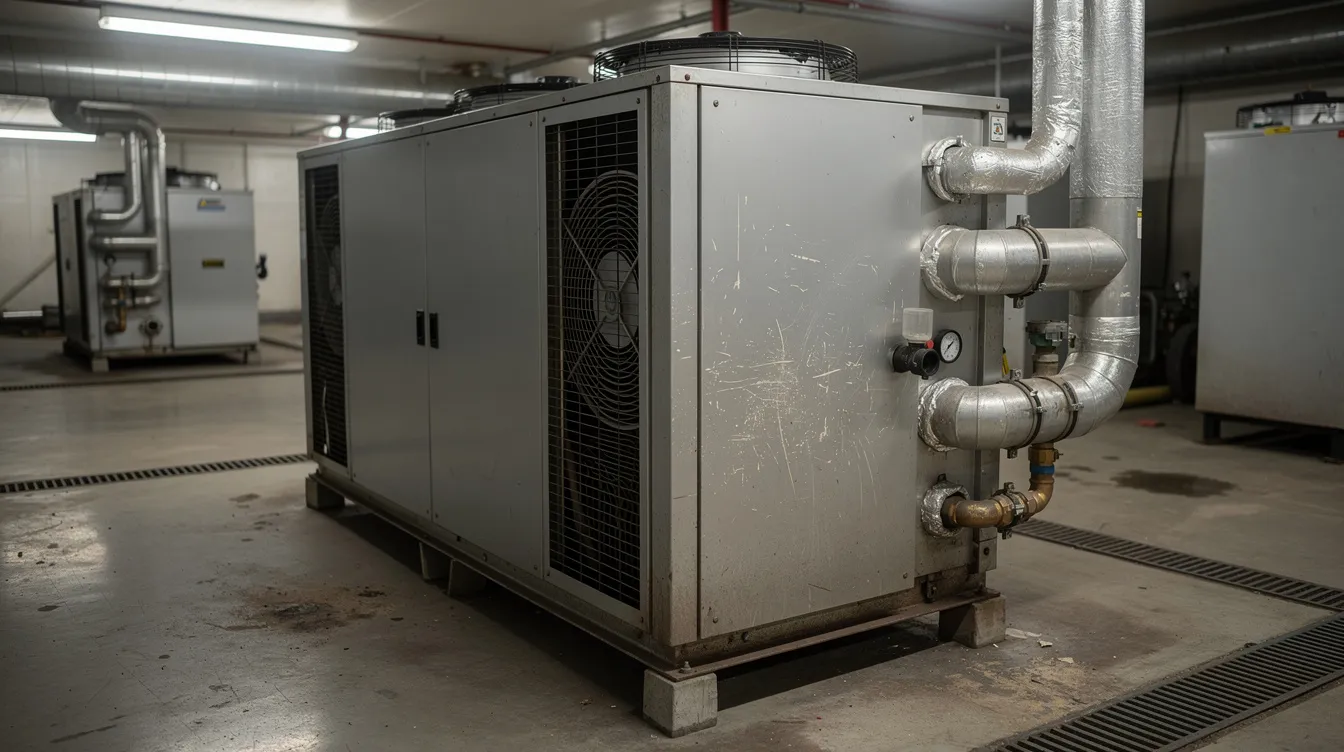
Cooling towers are heat rejection devices that use evaporative cooling to lower water temperature by dissipating excess heat into the ambient air. Chillers, on the other hand, remove heat from liquids through a vapor-compression refrigeration cycle, offering precise temperature control. Chillers come in air-cooled and water-cooled variants, with the latter often paired with cooling towers in large-scale HVAC systems. In a cooling system, cooling towers primarily reject waste heat, while chillers absorb heat from processes or spaces requiring controlled cooling.
Cooling Towers: Operation, Cooling Process, and Water Quality Implications
Cooling towers operate on the principle of evaporative cooling. Hot water is sprayed over fill media to maximize surface area while air blows through the tower, promoting evaporation and heat dissipation. The circulating cooling water gives up heat as the water stream passes through the tower. This evaporation removes unwanted heat from the remaining water. The cycle of concentration (CoC) is a key parameter representing the ratio of dissolved solids in the circulating water to makeup water, directly impacting scaling and corrosion risks. Typical water treatment challenges include preventing scale formation, biological growth, and corrosion. Primary monitoring parameters involve water chemistry, CoC, and microbial levels to maintain cooling efficiency. The larger contact area created by fill media helps maximize efficiency.
How Cooling Towers Work: Fill, Drift, and Cooled Water Management
In a cooling tower, hot water from the system is pumped to the top and distributed over fill media, enhancing heat exchange by increasing water-air contact. Air flows upward or downward depending on tower design, such as induced draft cooling towers or counterflow cooling towers. The incoming airflow carries away hot air from the tower during heat rejection. During this process, some water evaporates, reducing water temperature, while drift eliminators capture water droplets entrained in the air stream to minimize water loss. Towers also depend on a constant supply of makeup water to maintain stable operation. Makeup water replenishes evaporated and blown-down water, maintaining system balance. Fouling and biofilm formation occur when contaminants accumulate on surfaces. These reduce heat transfer efficiency and necessitating regular cleaning and treatment.
Chillers and Air Cooled Chillers: Refrigeration Cycle and Water Considerations
A chiller removes heat from the system coolant, typically water or a water-glycol mix, and many chiller systems do this through the vapor compression cycle. The cycle involves evaporator heat exchangers where the coolant absorbs heat, compressors that raise refrigerant pressure, and condenser heat exchangers where heat is rejected. This cycle allows chillers to supply low-temperature water around 40-45°F. They are essential for applications that need water below 60°F-70°F and can maintain 70°F and below year-round. Air-cooled chillers dissipate heat directly into the surrounding air using fans. In air cooled systems those fans move cool air across the condenser, requiring no water, while water-cooled chillers use cooling towers to reject heat, involving additional water treatment. Water usage implications differ: air-cooled chillers conserve water but may have higher energy consumption, whereas water-cooled chillers require water management but offer greater cooling efficiency.
Cooling Tower vs Chiller: Technical Comparison for Water Treatment
Cooling towers generally consume less electrical energy per ton of cooling compared to chillers but use more water due to evaporation and blowdown. However, cooling towers cannot replace chillers because they do not produce chilled water. Cooling towers also use less energy overall and are typically more energy-efficient than chillers. In some operating conditions, they can be 3-5 times more efficient. Chillers provide more accurate and stable temperature control, essential for processes demanding precise temperature control. Maintenance for cooling towers focuses on chemical dosing to control scale and biological growth, while chillers require monitoring of refrigerant levels and mechanical components. Capital costs for chillers tend to be higher, but lifecycle costs depend on energy consumption, water availability, and maintenance requirements.
Cooling Towers and Chillers Working Together: Integrated Cooling Process
In many large-scale HVAC systems, water-cooled chillers and cooling towers operate in tandem as a closed loop system for heat removal and heat rejection. The chiller unit absorbs heat from the process fluid and transfers it through a heat exchanger to a condenser water loop connected to the cooling tower. The cooling tower then dissipates this excess heat to the atmosphere through evaporative cooling. Together, this pairing provides efficient cooling and is often 20-30% more energy efficient than standalone alternatives. Effective control strategies balance load demands between the chiller and tower, optimizing energy efficiency. Treatment sequencing is vital to manage shared water loops, ensuring consistent water quality and minimizing corrosion and fouling.
Design and Operation Best Practices for Cooling Systems
Maintaining a target CoC and conducting regular water sampling are fundamental for system health. Biocide and scale inhibitor programs should be tailored to prevent biological growth and scaling. Variable frequency drives (VFDs) on fans and pumps help maximize energy efficiency by adjusting air flows and water circulation based on cooling demand. Key performance indicators (KPIs) such as water temperature, conductivity, and microbial counts provide actionable insights into system performance.
Case Studies: Cooling Tower vs Air Cooled Chiller Scenarios
In high-heat industrial plants, cooling towers paired with water-cooled industrial chillers efficiently manage large heat loads in industrial processes such as food processing. Conversely, water-restricted hospitals or urban facilities often rely on air-cooled chillers to minimize water consumption while maintaining precise temperature control. These systems can also be useful in large commercial buildings located in areas facing water scarcity. Retrofit projects frequently combine both technologies to maximize cooling capacity and energy efficiency while addressing site constraints, with a portable cooling tower sometimes used for smaller or temporary deployments.
Regulatory, Environmental, and Water Conservation Considerations
Permitting for discharge and blowdown water requires adherence to environmental regulations. Legionella risk management involves regular microbial monitoring and treatment protocols to ensure occupant safety. Water-saving strategies include optimizing blowdown cycles, reusing treated water, and selecting between water-based equipment and air cooled systems based on regional water scarcity and lower energy consumption goals.
Decision Framework: Choosing Between Air Cooled Chiller and Cooling Towers
Selecting between air-cooled chillers and cooling towers depends on site constraints such as water availability, ambient temperature, required process fluid temperature, and whether consistent temperature control is needed. This is because chillers are less affected by ambient weather conditions, especially at demanding sites from power plants to other critical facilities. Lifecycle cost analysis should weigh capital investment against operational expenses and water costs. Pilot-treatment trials are recommended to validate water treatment approaches before full-scale implementation.
Maintenance Checklist for Cooling Towers and Chillers
Routine maintenance for cooling towers and chillers involves several key tasks to ensure reliable operation and maximize cooling efficiency. These include:
- Cleaning the basin and fill media to prevent fouling
- Monitoring blowdown and makeup water chemistry
- Inspecting chiller compressors, refrigerant levels, and mechanical seals
- Validating sensor accuracy and control system alarms Adhering to these maintenance practices supports optimal system performance and longevity.
Conclusion and Action Items for Water Treatment Teams
Water treatment specialists should prioritize understanding system design and operational parameters to optimize cooling tower and chiller performance. Immediate actions include assessing water quality, establishing monitoring protocols, and reviewing treatment programs. Consulting relevant standards and continuing education resources will support ongoing system reliability and efficiency.
For cooling tower services, contact our team today.
Frequently Asked Questions (FAQs)
What is the main difference between a cooling tower vs chiller?
A cooling tower removes heat from water using evaporative cooling to reject heat into the atmosphere, while a chiller uses a refrigeration cycle to remove heat from liquids and provide precise temperature control.
Can a cooling tower replace a chiller in all applications?
No. Cooling towers cannot produce chilled water and are limited by ambient wet bulb temperatures, making them unsuitable for applications requiring low-temperature water that chillers provide.
How do cooling towers and chillers work together in large-scale systems?
In large-scale HVAC systems, water-cooled chillers absorb heat from processes and transfer it to cooling towers, which then reject the heat through evaporative cooling, creating an energy-efficient integrated cooling loop.
What are the water treatment challenges associated with cooling towers?
Cooling towers require treatment to prevent scaling, corrosion, and biological growth due to water evaporation and blowdown. Maintaining proper water chemistry and cycle of concentration is essential for efficiency and system longevity.
Are air-cooled chillers more water-efficient than water-cooled chillers?
Yes. Air-cooled chillers dissipate heat directly to the air and do not require water for cooling, making them more water-efficient but often less energy-efficient compared to water-cooled chillers paired with cooling towers.
What maintenance is required for chillers and cooling towers?
Cooling tower maintenance includes regular cleaning of fill media, monitoring water chemistry, and controlling microbial growth. Chillers require inspections of compressors, refrigerant levels, and mechanical components to ensure optimal performance.
How does ambient climate affect cooling tower performance?
Cooling towers rely on ambient wet bulb temperatures for heat rejection, so their efficiency can decrease in hot, humid climates, whereas chillers provide consistent cooling regardless of outdoor conditions.
What factors should water treatment specialists consider when choosing between a cooling tower and a chiller?
Key factors include required coolant material temperature, water availability, ambient climate, heat load size, energy efficiency goals, and maintenance capabilities to select the most suitable cooling solution.
