
This article aims to provide clear, practical guidance on cooling water systems in industrial settings. Readers can expect a comprehensive overview of system types, key components, water chemistry risks, and treatment technologies.
Key Takeaways
- Cooling water systems are critical for managing heat loads in various industrial processes, ensuring equipment safety and efficiency.
- Selecting the appropriate cooling system type depends on water availability, environmental regulations, and operational goals.
- Regular monitoring and chemical treatment are essential to prevent scale, corrosion, and microbiological growth.
- Advances in materials and filtration technologies enhance system durability and reduce maintenance demands.
- Integrating closed-loop and chilled water systems can improve energy efficiency and reduce water consumption.
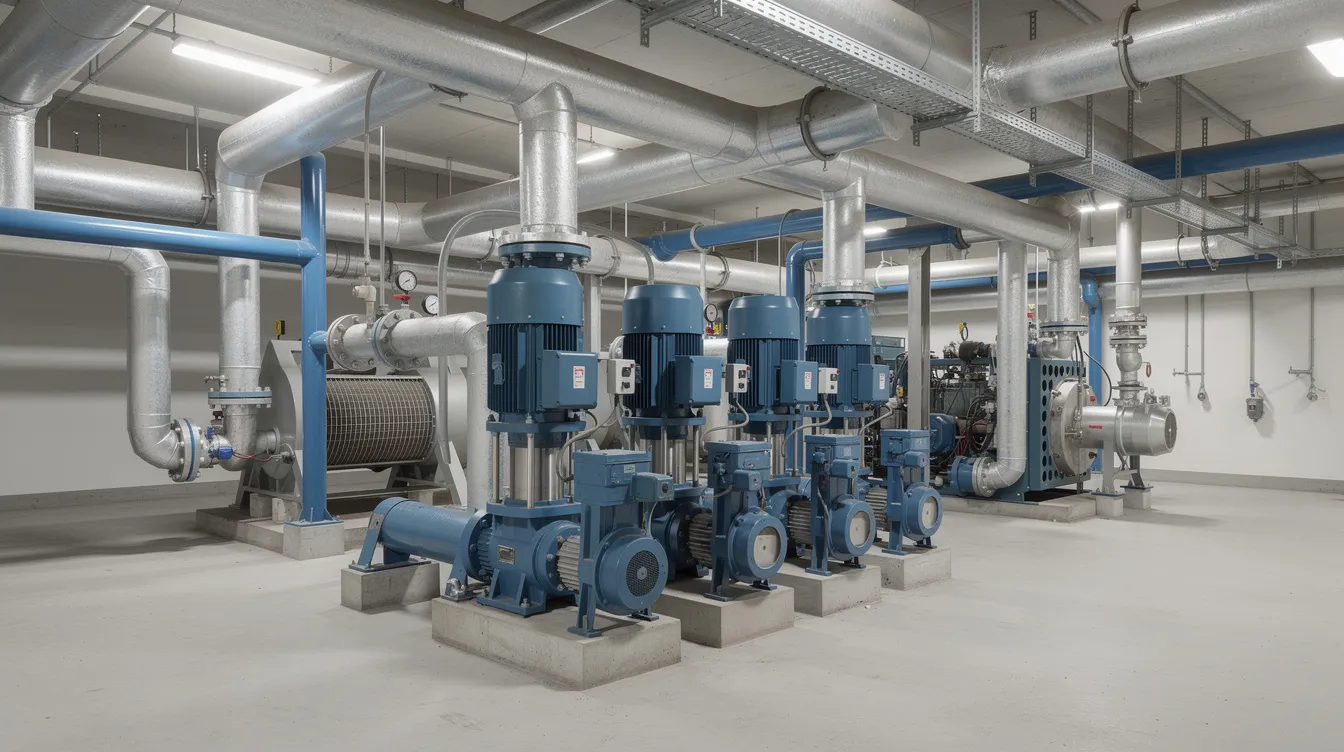
Cooling Water Systems Overview
Industrial cooling water systems typically fall into three categories: once-through, open recirculating, and a sealed category often described as a closed system or closed-loop systems. Each type presents unique challenges and opportunities for water treatment. Once-through cooling is commonly referred to as a direct-use approach in some industry discussions. Common risks include scale formation, corrosion, and biological fouling, all of which can impair heat transfer and equipment longevity. Tracking key performance metrics such as conductivity, pH, and cycles of concentration is essential for effective system management. More than 1,200 U.S. power plants use once-through cooling systems. The EPA issued cooling water intake regulations in 2001 and 2014.
Cooling System Types and Heat Rejection Paths
Cooling water systems in industrial facilities can be categorized into several types, each with distinct characteristics and operational considerations:
- Once-through systems:
- Draw water from natural sources such as lakes or rivers.
- Pass water through heat exchangers to absorb heat.
- In once through cooling, warmed water is discharged back to the original source after heat exchange.
- Over 1,200 U.S. power plants use these systems.
- Consume millions of gallons of water daily.
- Warm water discharge can harm aquatic life.
- These systems kill billions of fish annually.
- Open recirculating systems:
- Use cooling towers to dissipate heat primarily via evaporative cooling.
- Reuse and recycle most of the water within the system.
- Maximize efficiency through evaporation.
- May face regulatory challenges due to environmental concerns.
- Closed-loop systems:
- Operate as a closed system, circulating treated water within a sealed circuit with low evaporation and makeup needs.
- Often coupled with chillers for process or comfort cooling.
- Minimize water loss and reduce chemical treatment needs.
- Condenser water in cooling towers:
- Helps in removing heat from process fluids.
- Works in conjunction with chilled water systems supplying low-temperature water for cooling applications.
Open Recirculating Systems
Mechanical draft cooling towers use fans to respond to ambient air temperature as operating conditions change and remove heat through evaporative cooling. Key points include:
- Mechanical draft towers use fans to pull air upward for efficient evaporative cooling of warm water sprayed over fill media.
- Towers are designed as crossflow or counterflow, with water and air flowing in different directions to optimize heat transfer.
- Evaporation removes latent heat, cooling water by about 10°F, with wet bulb temperature setting the practical cooling limit.
- Drift eliminators minimize water loss as droplets, while blowdown controls dissolved solids concentration.
- Makeup water replaces losses from evaporation, drift, and blowdown, enabling cooling towers to recycle about 98% of water used.
- Tower water flow and heat load variations affect thermal performance and efficiency.
Cooling Tower Components and Heat Exchanger Interfaces
Key tower components include the fill for efficient heat transfer, drift eliminators to minimize water loss, and the tower basin that collects cooled water. Heat exchangers interface with cooling towers via condenser water loops, where hot water returning from the process is cooled and tower water leaves the basin back to the load as cold water. At these interfaces, carbon steel and galvanized steel are common materials, so corrosion control matters. It’s critical to monitor inlet and outlet temperatures, flow rates, heat load, circulating water quality, and water chemistry at these points to ensure optimal performance.
Closed-Loop and Chilled Water System Integration
Closed-loop systems offer advantages such as reduced water consumption and lower chemical treatment costs because they are isolated from ambient air. This design also has low evaporation and lower make up water demand than open tower circuits. In larger facilities, this often supports a water cooled integration approach with better energy efficiency.
Chilled water systems circulate water typically between 40°F and 45°F to provide process or air conditioning cooling. Refrigeration systems supply that chilled water in many installations. These loops interact with condenser water circuits, often through heat exchangers, and in suitable applications plate-and-frame units can be a lower cost option than shell-and-tube designs when transferring waste heat to cooling towers or other heat rejection equipment. In suitable applications, these configurations can be especially energy efficient and cooling towers may reduce energy costs by up to 40%. Some designs also use multiple pumps for redundancy or flow control while maintaining high efficiency.
Cooling Water Chemistry Risks and Control Targets
Managing scale, corrosion, and biological fouling is vital. Typical control targets include maintaining conductivity within set limits to prevent scale formation. Polyphosphates are commonly added to reduce scale formation in cooling systems. Controlling pH and using corrosion inhibitors helps minimize corrosion, especially under high temperatures. Achieving cycles of concentration appropriate to the facility’s water quality and operational constraints also helps limit microbiological fouling that can reduce heat transfer efficiency and system cleanliness.
Microbiological Control and Legionella Risk Management
Routine biocide dosing, often with chlorine, helps control Legionella bacteria in cooling water, and water cooling towers are a common risk point when treatment is poor. Ozone treatment is another option that effectively kills bacteria and algae. Regular Legionella sampling and a documented prevention plan are mandatory in many jurisdictions. Biofilm removal through shock dosing, typically with hydrogen peroxide at 500–3,000 ppm, scheduled physical cleaning of tower fill, and side-stream filtration to reduce solids load are effective mitigation techniques. Proper cleanliness also depends on limiting biological growth and reducing sunlight exposure.
Water Treatment Technologies for Cooling Water Systems
Treatment options include filtration to remove suspended solids, water softening or ion exchange to control hardness, and reverse osmosis (RO) for blowdown recovery, with cost often guiding technology choice. Selecting appropriate technologies depends on water quality, system design, and environmental regulations. By comparison, air cooling or dry cooling systems can also be evaluated against maintenance costs, but they often have higher installation costs because of added energy requirements.
Side-Stream Filtration and Heat Exchanger Protection
Side-stream filtration typically processes 5–10% of the total flow to remove particulates that can cause fouling, while protecting circulating water quality in open systems. Controlling recirculating water cleanliness improves heat exchanger protection and supports efficient heat transfer. Particle size targets are set to protect sensitive membrane and heat exchanger surfaces, especially at water pipes and exchanger connection points. Monitoring differential pressure across filters indicates performance and cleaning needs.
Ultrafiltration, Multimedia, and Cartridge Choices
Ultrafiltration offers fine particle removal but requires periodic regeneration. Multimedia filters provide effective suspended solids removal with lower operating costs. Cartridge filters capture smaller particles and are selected based on solids retention requirements
Optimizing Cooling Water System Performance
Effective cooling water systems are essential for maintaining operational efficiency and equipment longevity in industrial facilities and other heat-intensive industrial processes. Whether utilizing once-through, open recirculating, or closed-loop designs, proper water treatment and system maintenance are critical to controlling scale, corrosion, and biological fouling, while cooling towers also depend on make up water to replace evaporation losses.
Implementing advanced filtration, chemical dosing, and monitoring strategies can significantly reduce operating costs and mitigate risks such as Legionella outbreaks, and tower manufacturers often support these efforts through design choices that improve durability and thermal performance.
For tailored solutions and expert support in optimizing your cooling water system, contact our team today to learn how we can help improve your system’s performance and reliability.
Frequently Asked Questions (FAQs)
What is a cooling water system and why is it important in industrial facilities?
A cooling water system is a network designed to remove excess heat from industrial processes using water as the cooling medium. It is essential for preventing equipment overheating, ensuring operational efficiency, and extending equipment life.
What are the main types of cooling water systems used in industry?
The primary types include once-through systems that use fresh water once before discharge, open recirculating systems that reuse water with cooling towers, and closed-loop systems that circulate treated water within a sealed circuit.
How do cooling towers work in open recirculating systems?
Cooling towers remove heat through evaporative cooling, where warm water is sprayed over fill media to increase surface area, and air is drawn or forced through the tower to evaporate a portion of the water, thereby cooling the remainder.
What are common water chemistry challenges in cooling water systems?
Challenges include scale formation from dissolved minerals, corrosion of metal components, and biological fouling such as biofilms and algae growth, all of which can reduce heat transfer efficiency and damage equipment.
How is Legionella risk managed in cooling water systems?
Legionella bacteria thrive in warm, wet environments like cooling towers. Risk management involves routine biocide dosing, regular monitoring, physical cleaning of tower components, and maintaining proper water chemistry to inhibit bacterial growth.
What role does side-stream filtration play in cooling water treatment?
Side-stream filtration removes suspended solids from recirculating water, reducing fouling potential, protecting heat exchangers, and improving overall system cleanliness and efficiency.
Why is cycles of concentration important in cooling water systems?
Cycles of concentration measure the concentration of dissolved solids in recirculating water relative to makeup water. Managing this parameter helps optimize water usage, minimize blowdown, and control scaling and corrosion risks.
What materials are commonly used in cooling tower construction?
Cooling towers are commonly constructed from materials such as fiberglass reinforced plastic (FRP), galvanized steel, and engineered plastics like high-density polyethylene (HDPE), chosen for durability and corrosion resistance.
How does natural draft cooling differ from mechanical draft cooling towers?
Natural draft cooling towers rely on the buoyancy of rising hot air to induce airflow without fans, typically featuring large hyperbolic structures. Mechanical draft towers use fans to actively move air through the tower for more controlled cooling.
How can cooling water systems help reduce energy costs?
By efficiently removing heat and optimizing water treatment, cooling water systems, particularly those with well-designed cooling towers, can reduce energy consumption by up to 40%, contributing to significant operational cost savings.
