
Cooling tower blowdown plays a critical role in maintaining water quality, preventing scaling and corrosion, and ensuring compliance with environmental regulations. Understanding and managing blowdown effectively is key to optimizing cooling tower performance and protecting system longevity. This article is tailored for providing a clear and practical overview of cooling tower blowdown.
Key Takeaways
- Blowdown is vital for managing dissolved solids and sustaining cooling tower efficiency.
- Proper blowdown balances water conservation with the prevention of scaling and corrosion.
- Automated conductivity control enhances precision in blowdown management.
- Selecting appropriate treatment methods depends on blowdown water characteristics and reuse goals.
- Environmental regulations necessitate careful monitoring and compliant disposal of blowdown water.
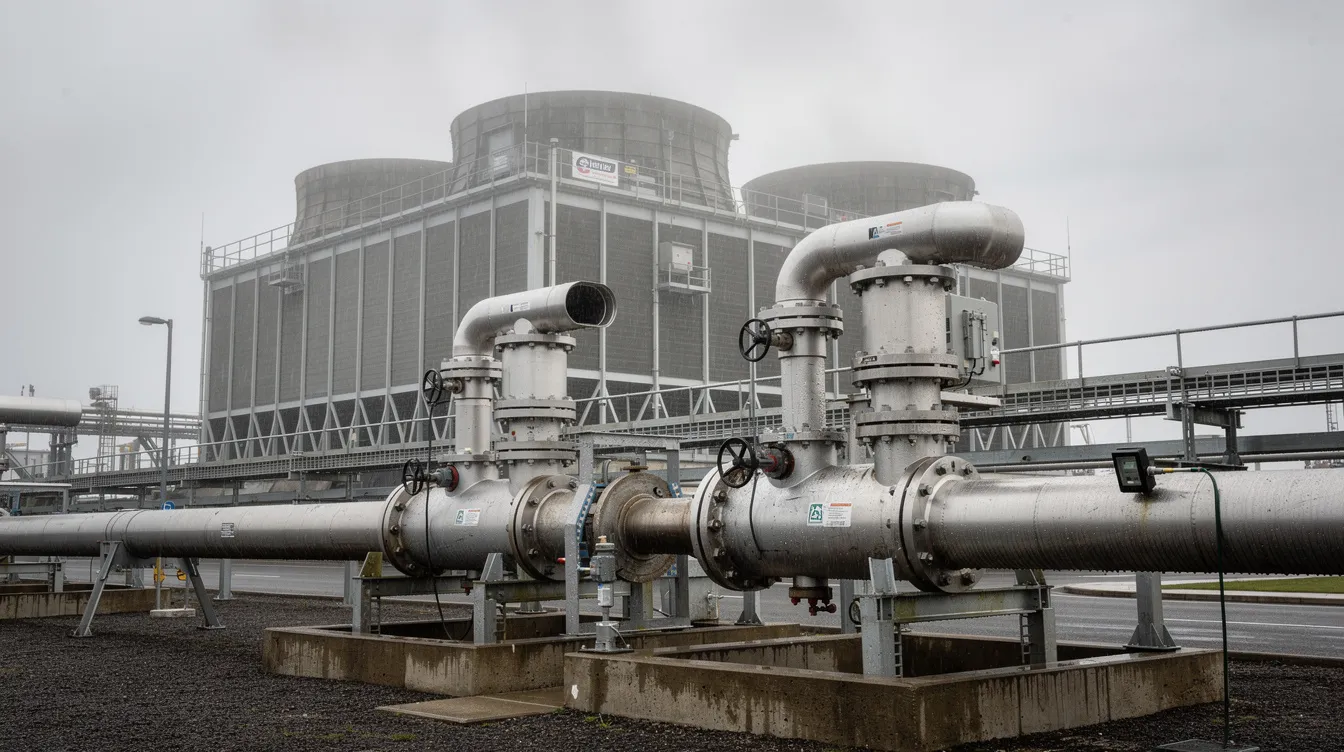
Cooling Tower Water Mass Balance and Makeup Water
A fundamental equation governs the water balance in a cooling tower system:
Makeup Water = Evaporation + Blowdown + Drift
Makeup water replenishes losses and typically has defined quality parameters such as low total dissolved solids (TDS) and controlled mineral content. Evaporation loss occurs as water evaporates to remove heat, leaving behind dissolved solids that concentrate in the circulating water. Drift and leakage constitute minor water loss streams but can impact overall water consumption. Tower blowdown is the intentional removal of a portion of the concentrated circulating water to control dissolved solids and maintain the system’s water quality.
Calculating Blowdown Rate and Cycles Of Concentration
Cycles of concentration (CoC) represent the ratio of dissolved solids in the cooling tower water compared to the makeup water and are commonly measured using conductivity ratios. The primary blowdown rate is directly related to evaporation and inversely related to CoC, so increasing cycles of concentration reduces blowdown volume while still balancing water conservation with scale and corrosion prevention. Key inputs for blowdown rate calculation include the system’s recirculation rate, the temperature difference (ΔT) across the cooling tower, and the makeup water quality. It’s important to be aware of common pitfalls, such as inaccurate conductivity readings or neglecting ambient air conditions, since engineers use these inputs to determine appropriate blowdown frequency or setpoints.
Formulas and Worked Examples
The blowdown rate (B) can be calculated by the formula:
B = E / (CoC – 1)
where E is the evaporation loss. Evaporation can be estimated using the rule-of-thumb:
E = 0.00085 × Recirculation Rate × ΔT
For example, if the recirculation rate is 1,000 GPM and ΔT is 10°F, evaporation loss is approximately 8.5 GPM. If the conductivity of tower water is 1,500 µS/cm and makeup water is 500 µS/cm, CoC is 3. Using these values, the blowdown rate is:
B = 8.5 / (3 – 1) = 4.25 GPM
This calculation guides water treatment specialists in optimize blowdown decisions for system performance.
Tower Blowdown Optimization for Cooling Systems
Optimizing the broader cooling system involves setting target CoC levels based on water quality and system design. A conductivity controller can automate the blowdown process, allowing dynamic adjustments that minimize water consumption and chemical usage. Incorporating side-stream filtration reduces suspended solids load by removing particles down to 5 microns, and high concentrations of suspended solids can promote bacterial and algal growth, while optimizing drift eliminators decreases water losses by reducing drift loss. Regular review of makeup water quality ensures adjustments align with changing source conditions. Proper blowdown with treatment chemicals also helps control harmful microorganisms in cooling water.
Water Treatment Options for Cooling Tower Blowdown
Treatment methods vary depending on blowdown water composition, and water from a cooling tower may require different approaches based on its chemistry and reuse goals. Sedimentation and clarifiers effectively remove suspended solids, while multimedia filtration targets finer particulates. Ion-exchange processes are suitable for removing specific ions that contribute to scaling like calcium, magnesium, and silica. Minerals can form scale on heat exchange surfaces and tower fill, and this scale acts as a thermal insulator that reduces cooling efficiency. Reverse osmosis offers high-quality water suitable for reuse but involves higher capital costs. Chemical conditioning complements physical treatments by controlling scale formation and corrosion.
Treatment Selection Criteria
Selecting treatment options requires analyzing blowdown composition, balancing capital and operating costs, and adhering to regulatory discharge limits. Cooling tower design and tower design also affect treatment selection and discharge strategy. In many facilities, a water treatment specialist helps determine practical limits for reuse, discharge, and cycles of concentration while evaluating these factors to design compliant and cost-effective systems.
Monitoring Cooling Water and Blowdown Rate Control
Accurate monitoring relies on strategically placed conductivity sensors calibrated regularly, because poor control of concentrated impurities can accelerate corrosion. Careful monitoring and flow measurements supporting day-to-day control. Sampling frequency and laboratory analyses for parameters such as TDS and pH support operational decisions. Flow meters are commonly used to track water flow rate and overall flow for blowdown control and reporting. Integrating blowdown controls with building automation systems facilitates real-time adjustments through the blowdown valve as part of the control loop. Setting alarm thresholds and corrective-action protocols ensures prompt response to deviations.
Environmental Compliance and Blowdown Disposal
Compliance requires understanding discharge consent parameters, including temperature, biocide levels, and chemical concentrations, to protect the environment through compliant blowdown disposal. Decisions between sewer discharge and onsite treatment depend on local regulations, system capabilities, and discharge planning that reflects industrial processes and site-specific operating conditions. Where sewer discharge is allowed, checking for sewer credits can also reduce blowdown wastewater costs. Treated blowdown water may be reused onsite for non-potable applications, contributing to water conservation efforts.
Practical Examples: Blowdown Rate Calculations and Optimization
Consider a factory with a 1,000 GPM recirculation rate and ΔT of 10°F, where fresh water quality and recirculated water conditions determine how far operators can safely raise CoC. By adjusting CoC from 3 to 5, the blowdown rate decreases from 4.25 GPM to approximately 2.1 GPM, reducing water and chemical usage significantly. Excessive blowdown wastes water, while conductivity-based adjustments help determine better settings. Sensitivity analysis demonstrates how makeup water conductivity influences optimal blowdown settings.
Best Practices Checklist for Cooling Tower Water Treatment and Blowdown
To maintain effective control over your cooling tower blowdown process, consider implementing the following best practices:
- Establish and document conductivity setpoints tailored to each cooling tower system so they reflect the cooling tower design.
- Record periodic measurements of CoC, blowdown rates, and water flow rate where relevant.
- Schedule preventive maintenance for sensors, blowdown valves, conductivity controller components, and related equipment.
- Validate water treatment performance following any process or chemical changes.
Essential Actions for Optimizing Blowdown
Controlled cooling tower blowdown is essential to protect equipment, optimize system performance, and ensure environmental compliance. Combining chemical treatment, automated control, and appropriate water treatment technologies empowers facilities to conserve water and reduce operational costs. For expert guidance and tailored solutions, contact our team specializing in cooling tower systems and water treatment.
Frequently Asked Questions (FAQs)
What is cooling tower blowdown and why is it important?
Cooling tower blowdown is the controlled removal of water from the cooling tower system to reduce the concentration of dissolved solids. It prevents scaling, corrosion, and microbial growth, ensuring efficient cooling tower operation and prolonging equipment life.
How is the blowdown rate calculated?
The blowdown rate is calculated using the formula B = E / (CoC – 1), where B is the blowdown rate, E is the evaporation loss, and CoC is the cycles of concentration. This calculation balances water conservation with maintaining water quality.
What are cycles of concentration (CoC) in cooling towers?
Cycles of concentration represent the ratio of dissolved solids in the cooling tower water compared to the makeup water. Increasing CoC reduces blowdown volume but requires careful monitoring to avoid scaling and corrosion.
How does blowdown help control scaling and corrosion?
Blowdown removes concentrated dissolved minerals such as calcium carbonate and chlorides from the cooling tower basin, minimizing scale formation and reducing corrosion risk by controlling mineral and chloride levels.
What are common treatment methods for cooling tower blowdown?
Treatment methods include sedimentation, multimedia filtration, ion exchange, and reverse osmosis. These processes remove suspended solids, specific ions, and dissolved salts, enabling compliant disposal or reuse of blowdown water.
How does environmental compliance impact blowdown management?
Blowdown water often contains elevated total dissolved solids and other impurities that can harm water bodies. Compliance with discharge regulations requires monitoring parameters like temperature, chemical concentrations, and proper treatment or disposal.
Can blowdown water be reused?
Yes, treated blowdown water can be reused onsite for non-potable applications such as toilet flushing or cleaning, helping conserve water resources while meeting environmental standards.
What role do conductivity controllers play in blowdown control?
Conductivity controllers monitor water quality by measuring conductivity, which correlates with dissolved solids. They automate blowdown valve operation to maintain water quality within set limits, optimizing water use and chemical consumption.
