
Industrial boiler systems are vital in numerous industries, providing essential heat and steam for processes, power generation, and heating applications. This article offers a clear understanding of industrial boilers, highlighting core components, types, combustion processes, efficiency considerations, water treatment priorities, operational controls, and maintenance essentials to optimize system performance and safety.
Key Takeaways
- Industrial boiler systems convert fuel energy into steam or hot water to support diverse industrial needs.
- Selecting the appropriate boiler type and fuel source is crucial for operational efficiency and flexibility.
- Maintaining optimal water quality through treatment prevents damage and enhances system longevity.
- Advanced control systems and load management improve combustion efficiency and reduce emissions.
- Integrating heat recovery technologies can significantly lower fuel consumption and operational costs.
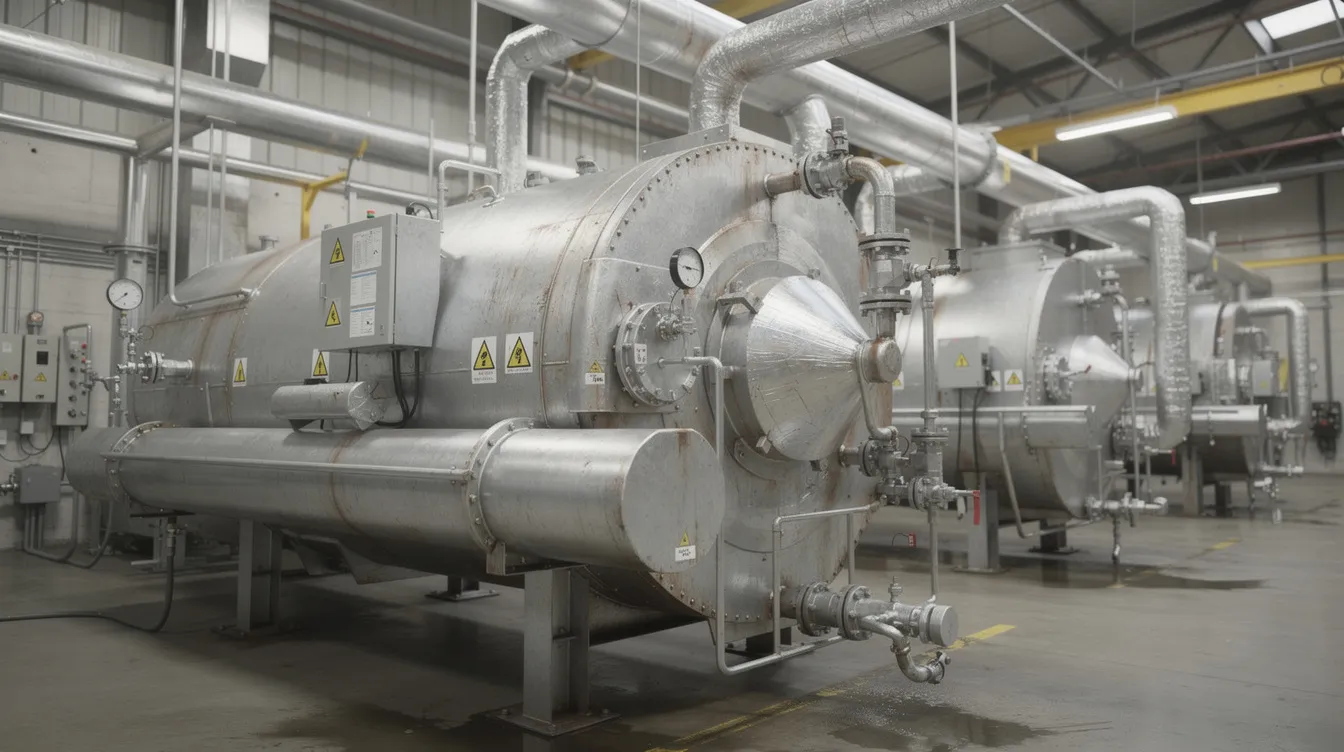
Industrial Boiler and Industrial Boiler Systems
An industrial boiler is a closed pressure vessel designed to generate steam or hot water by transferring thermal energy from fuel combustion to water. Unlike commercial boilers used for heating buildings or utility boilers in large power plants, industrial boilers serve a broad range of industrial heating applications, including chemical manufacturing, food processing, and power generation. Their key outputs include producing hot water, generating steam, both saturated and superheated, and supplying thermal energy to drive turbines or other equipment.
Core Components of an Industrial Boiler
Industrial boilers comprise several critical components working together to efficiently convert fuel into heat:
- Burner: Initiates fuel combustion by mixing fuel and air in the combustion chamber, ensuring optimal combustion efficiency.
- Heat Exchanger and Economizer: Transfer heat from hot combustion gases to water, raising its temperature and recovering waste heat to improve fuel consumption.
- Deaerator and Feedwater System: Remove dissolved gases such as oxygen and carbon dioxide from feedwater to prevent corrosion and maintain water quality.
Types of Industrial Boilers: Fire Tube Boiler, Water-Tube, Hot Water, and Industrial Steam Boilers
Boilers are classified based on their design and operational parameters, including pressure ranges and application suitability. They can be configured as modular units or single-vessel systems to meet varying steam demands.
Fire Tube Boiler: Design, Limits, and Water-Treatment Notes
Fire-tube boilers use fire tubes that carry hot combustion gases through water. Heat transfers from the hot gases to the water, generating steam. These boilers typically serve low to medium-pressure applications and require careful water quality management to avoid corrosion and scaling inside the tubes. They generally operate at lower pressure than water-tube units. Boiler explosions are rarer in water-tube designs than fire-tube designs. It’s essential to regularly inspect tube integrity to prevent failures.
Water-Tube Boiler: Benefits and Feedwater Implications
Water-tube boilers circulate water inside tubes heated externally by hot gases, allowing operation at higher steam pressure and temperature than fire-tube units and supporting high pressure service. Industrial water-tube units can exceed 100 bar, and in some services temperatures can rise above 500°C. Due to their design, they demand stricter water chemistry control to prevent scaling and corrosion, as water circulates directly through boiler tubes exposed to high thermal energy. This design is also generally more efficient than fire-tube boilers, which makes strong feedwater chemistry control even more important.
Hot Water Boilers: Operation and Treatment Priorities
Hot water boilers operate as closed-loop systems designed to create hot water or produce hot water for circulation rather than steam, making them a common choice in a heating system. Maintaining proper scaling and corrosion control is critical to ensure efficient heat transfer and prolong system life.
Heat Recovery Steam Generators (HRSGs) and Industrial Steam Boilers
HRSGs capture waste heat from gas turbines or other processes to produce steam, commonly used in combined-cycle power plants. They require careful monitoring of condensate quality and feedwater to mitigate thermal stresses caused by cyclic operation.
Combustion Process, Fuels, and Natural Gas Considerations
Combustion in industrial boilers involves burning fuel in the combustion chamber to create hot combustion gases. Common fuels include natural gas, oil, coal, and biomass, with natural gas favored for its cleaner combustion and ease of control, and natural gas boilers can achieve high thermal efficiency when operated with roughly 10-15% excess air. Burners regulate the air-fuel mixture to optimize combustion efficiency and reduce emissions such as NOx. Advanced air-fuel control strategies help mitigate pollutant formation, with flue gas monitoring helping optimize combustion and emissions.
How Steam Boilers Generate Heat and Produce Steam
Understanding the steam generation process in industrial boiler systems involves several key steps:
- The boiler furnace burns fuel to produce heat, serving as the system’s primary heat source.
- Heat exchangers transfer thermal energy from the hot combustion gases to the water, raising its temperature.
- As water reaches its boiling point, it generates saturated steam within the boiler.
- The steam expands to over 1,000 times its original volume, enabling its effective use in industrial applications.
- For specific uses, the saturated steam may be further superheated to increase its temperature.
- Finally, the generated steam is directed either to heating duties or to drive equipment such as turbines for electricity generation.
Boiler Efficiency: Measurement, Losses, and Improvement
Boiler efficiency measures how effectively fuel energy converts into usable steam or hot water. Modern modular or well-controlled arrangements are often more energy efficient and, in many applications, highly efficient because they reduce fuel waste. Efficiency is commonly assessed using direct and indirect methods. Primary heat losses arise from exhaust gases, radiation, blowdown, and unburned fuel. Installing economizers and blowdown heat recovery systems can recapture waste heat, improving fuel consumption and overall efficiency. Establishing baseline KPIs and conducting regular efficiency testing are recommended best practices.
Water Treatment Focus for Industrial Boilers
High-purity feedwater is essential to prevent scale formation and corrosion that degrade boiler performance. Chemical dosing targets include controlling hardness, alkalinity, and dissolved oxygen. Monitoring parameters such as dissolved oxygen and conductivity ensures water quality remains within safe limits. Closed-loop condensate recovery helps conserve water and energy while minimizing contaminants.
Operational Optimization and Controls
Oxygen-trim controls and combustion management systems optimize air-fuel ratios, enhancing combustion efficiency and reducing emissions. Load management strategies, including lead-lag sequencing of multiple boilers, align steam production with demand to minimize fuel wastage. Variable frequency drives (VFDs) on feedwater and combustion air fans improve energy efficiency by matching motor speeds to process requirements.
Heat Recovery, Power Generation, and HRSG Integration
In combined-cycle power plants, HRSGs utilize exhaust gases from gas turbines to generate steam, which can drive power turbines to generate electricity, while providing steam and hot water for both power and process needs in integrated facilities. Proper matching of HRSG design to turbine exhaust conditions and monitoring thermal and steam-side chemistry prevent damage and ensure reliable operation.
Maintenance, Safety, and Compliance for Industrial Boilers
Routine maintenance tasks include inspecting boiler tubes, valves, pumps, and cleaning to prevent residue buildup that reduces heat transfer. Safety valve testing and low-water protection devices are critical to preventing catastrophic failures such as boiler explosions, which are less common in water-tube boilers but still possible. Compliance with the ASME Boiler and Pressure Vessel Code and local regulations ensures design and operational safety standards are met.
Specifying and Procuring an Industrial Boiler System
When selecting an industrial boiler system, consider fuel types, capacity, steam quality, and operational flexibility. Feedwater quality guarantees should be stipulated in procurement to safeguard system longevity. Designing for accessibility facilitates routine water-treatment maintenance and inspections, supporting sustained efficient and safe boiler operation.
By understanding these fundamental aspects of industrial boiler systems, water treatment specialists can contribute effectively to optimizing boiler performance, ensuring safety, and supporting diverse industrial processes.
Maximizing the Value of Industrial Boiler Systems
Understanding the intricacies of industrial boiler systems is essential for water treatment specialists aiming to optimize performance, safety, and efficiency. From selecting the appropriate boiler type and fuel source to maintaining precise water chemistry and ensuring compliance with safety standards, every aspect plays a critical role in reliable steam generation and heat production. By integrating advanced operational controls, regular maintenance, and effective water treatment strategies, facilities can reduce energy costs, extend equipment lifespan, and support diverse industrial applications such as power generation, chemical processing, and food production. A well-specified and maintained industrial boiler system not only meets current operational demands but also provides flexibility for future growth and sustainability goals.
For inquiries on boiler water treatment services, contact our team today.
Frequently Asked Questions (FAQs)
What is the difference between a fire-tube and a water-tube industrial boiler system?
Fire-tube boilers have hot gases pass through tubes surrounded by water, suitable for low to medium-pressure applications. On the other hand, water-tube boilers circulate water inside tubes heated externally by combustion gases, allowing higher pressures and temperatures and generally offering greater efficiency.
Why is water treatment important in industrial boiler systems?
Proper water treatment prevents scale formation and corrosion, which can reduce heat transfer, lead to boiler failure, and cause safety hazards. Maintaining water quality ensures efficient steam generation and prolongs boiler lifespan.
What is superheated steam, and why is it used?
Superheated steam is steam heated beyond its boiling point at a given pressure, producing dry steam without water droplets. It carries more energy, reduces turbine blade damage, and improves efficiency in power generation and industrial processes.
How do industrial boilers create heat and generate steam?
Industrial boilers create heat by burning fuel in the combustion chamber. The hot gases pass through heat exchangers where heat transfers to water, raising its temperature until boiling water turns into steam. This steam can be saturated or superheated depending on the system design.
What auxiliary equipment is commonly used with industrial boiler systems?
Auxiliary equipment includes deaerators, economizers, feedwater pumps, and control systems. These components support water treatment, heat recovery, feedwater delivery, and operational control to optimize boiler performance and safety.
How can boiler efficiency be improved?
Efficiency improves by recovering waste heat with economizers, optimizing combustion air-fuel ratios with advanced controls, reducing blowdown losses, and maintaining clean heat transfer surfaces. Regular monitoring and maintenance are also critical.
What safety standards apply to industrial boiler systems?
The ASME Boiler and Pressure Vessel Code sets comprehensive safety standards for design, construction, and operation. Compliance with these and local regulations helps prevent accidents like boiler explosions and ensures safe operation.
How does steam generated by industrial boilers support industrial processes?
Steam expands to over 1,000 times its original volume, providing a versatile energy source for heating, sterilization, power generation, and driving mechanical equipment in industries such as chemical processing and food production.
