
Commercial water softener installation requires precise planning to handle high water volumes in hotels, food plants, healthcare buildings, laundries, commercial kitchens, and institutional facilities. A correctly installed commercial water softener system protects equipment and reduces operating costs.
In general, a commercial water softener system handles about 20–300 GPM per train, while industrial systems may exceed that range and operate under heavier duty cycles. Key components include resin tanks, a brine tank, control valve, bypass valve, main water line, electrical connections, and drain.
Key Takeaways
- Commercial water softener installation requires thorough planning to accommodate high flow rates and peak demand.
- Installation must comply with manufacturer’s recommendations and local plumbing, electrical, and building codes to ensure safety and performance.
- Pre-filtration protects the resin bed from trace amounts of iron, manganese, and sediment, extending resin life and maintaining water quality.
- Site selection should consider space, temperature control (40–120°F), drainage, electrical access, and ease of maintenance to optimize system reliability.
- Regular testing of treated water hardness post-installation verifies system effectiveness and informs maintenance schedules.
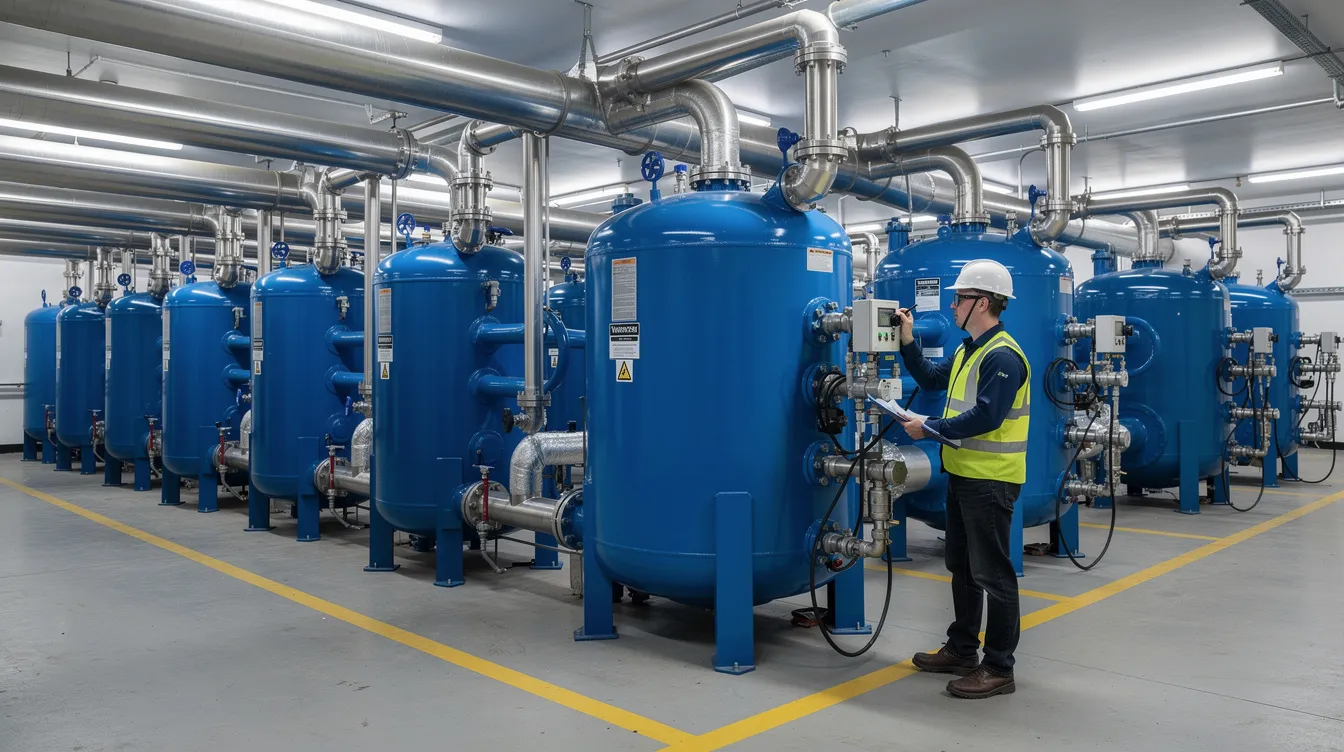
Commercial & Industrial Water Softening Basics
Commercial water softening is installed to reduce scale buildup, protect boilers, improve hot water heaters efficiency, stabilize cooling tower programs, and prevent commercial dishwashers from premature failure. Hard water contains high levels of calcium and magnesium which cause premature failures in equipment. On the other hand, softened water reduces energy costs by improving system efficiency, and scale buildup increases energy costs in commercial facilities.
Before system design, confirm:
- Total water hardness as CaCO₃, in mg/L or grains per gallon.
- Iron and manganese, as pre-filtration protects the resin bed of the softener from dirt and heavy metals.
- Alkalinity, pH, chlorine/chloramine, suspended solids, and total dissolved solids.
- Continuous flow, peak demand, water usage, and gallons per day.
Commercial water softening systems differ from residential units in resin volume, valve size, regeneration control, and redundancy. Commercial units may be simplex, duplex, triplex, or multi-tank systems. Many U.S. supplies run 10–40 gpg, and commercial systems are often designed around 8–12 gpm/ft² of resin bed area.
Types of Commercial Water Softening Systems
Aside from hardness, system configuration is driven by flow rates, redundancy requirements, installation space, and duty cycle. The different types of configurations are as follows:
- Simplex: one tank; best where regeneration downtime is acceptable.
- Duplex alternating: one tank in service while one regenerates; strong fit for hotels and healthcare.
- Twin-parallel: both tanks share demand and regenerate as needed.
- Multi-tank systems: scalable for heavy industrial demands in water softening and high peak flow.
Ion exchange commercial water softeners are the standard when the goal is to remove minerals to a measurable hardness specification. Salt-free systems, on the other hand, transform minerals into non-scaling crystals, but they do not remove dissolved minerals or reduce hardness test results.
Ion Exchange Commercial Water Softeners
Ion exchange systems soften water by replacing calcium and magnesium ions with sodium or potassium ions using special resin beads. These beads trap hardness minerals and release them during regeneration with salt brine. This reliable process is widely used because it offers predictable performance and efficient salt use.
Typical applications include hotels, hospitals, laundries, food and beverage pre-treatment, light industrial boiler make-up, HVAC systems, and cooling tower make-up. Commercial water softeners handle hundreds to thousands of gallons per hour depending on configuration.
Salt-Free and Alternative Commercial Water Systems
Salt-free commercial water systems, including template-assisted crystallization and nucleation-assisted crystallization, change mineral behavior but do not reduce water hardness. They may be considered for low to moderate hardness, non-critical heat-transfer equipment, or where chloride discharge limits are strict. They do not produce true soft water for process specs, and high-temperature or high-pressure expectations can exceed their practical range.
Pre‑Installation Assessment and Design
Complete sizing and design should be done before cutting pipes or setting tanks. To ensure a smooth installation, site surveys must confirm space availability, drain access, electrical outlets, floor loading, ceiling height, building access, water line routing, and soft water distribution points.
Additionally, it’s important to review P&IDs, verify the water source, and map inlet and outlet locations. Furthermore, aligning control valve operation with facility hours helps achieve optimal performance.
Water Testing and Pretreatment Needs
Test hardness, iron, total dissolved solids, manganese, chlorine/chloramine, suspended solids, and pH. Iron above 0.3 mg/L typically requires pre-filtration or iron removal; carbon filters protect resin from chlorine damage.
Poor pretreatment shortens resin life and increases hardness leakage, detergent use, and staining. Softened water improves beverage and linen quality, reducing chemical detergent needs.
| Input | Example |
|---|---|
| Hardness | 171 mg/L ÷ 17.1 = 10 gpg |
| Daily volume | 20,000 gallons |
| Capacity/day | 200,000 grains |
| 2-day run + 20% safety | 480,000 grains |
Sizing Commercial Water Softeners
Proper sizing prevents frequent regeneration and hard water breakthrough or wasted salt and space. Calculate capacity based on flow rate, hardness, daily volume, regeneration frequency, and safety factors. The peak flow rate determines the appropriate valve size: larger tanks and more complex plumbing configurations are necessary to accommodate higher flow demands. Select tank diameter and valve to maintain recommended gpm/ft² and pipe velocity (6–8 ft/s) using copper or steel mains.
Choosing the Installation Location
Location affects hydraulics, service access, safety, and code compliance. Install the unit near the main water line, generally downstream of the meter, booster set, and required backflow protection, and upstream of water heaters and major process loads. This reduces pressure loss, avoids unnecessary pipe runs, and limits dead legs where hard water can bypass treatment.
Account for ceiling height, brine tank access, resin change-out, skid footprint, forklift or pallet-jack access, and working clearance. A simple layout is: main water line to inlet isolation valve, pre-strainer, resin tank and control valve, outlet isolation valve, three-valve bypass, brine tank beside the softener, and drain line to an air-gapped floor drain.
Space, Access, and Environmental Conditions
Provide 24–36 inches near the valve side where possible for service. Keep the installation area temperature between 40–120°F, avoid freezing, and avoid corrosive fumes. Drain proximity also matters. A 2 ft³ commercial unit may discharge 5–15 gpm during backwash and hundreds of gallons across regeneration, depending on programming. Large systems may require anchoring, seismic restraints, and spill containment.
Step‑by‑Step Commercial Water Softener Installation
Commercial water softener installation must follow manufacturer guidelines and local plumbing, electrical, and building codes. Installations typically take one to three days, depending on pipe size, controls, drain routing, and commissioning.
Key steps include isolation, mechanical setup, plumbing, bypass valve installation, brine tank placement, drain routing, electrical connections, programming, and performance checks. Use lockout/tagout, verify depressurization, and wear PPE during cutting, welding, soldering, and electrical work.
Isolation, Layout, and Mechanical Setup
- Shut off and isolate the main water supply, drain downstream pipes, and lock out pumps.
- Align resin tanks, brine tank, and control heads to minimize elbows and head loss.
- Level tanks and skids.
- Large tanks may need dollies or pallet jacks.
Piping, Bypass Valve, and Valves
- Use copper or schedule 80 PVC pipes rated for commercial water pressure.
- Industrial-grade pipes connect to the softener.
- Install a three-valve bypass for maintenance without shutting off water.
- Add upstream/downstream isolation valves, unions, pre-strainers, and pressure gauges.
- Confirm control valve orientation and use potable thread sealant or Teflon tape.
Brine Tank Placement and Connections
- Position the brine tank within manufacturer limits (usually 1–10 feet from valve) with salt delivery access.
- Assemble brine well, safety float, air check, and overflow fitting.
- Route brine line without kinks or unsupported runs.
- Fill with commercial-grade salt to recommended levels.
Drain, Overflow, and Waste Handling
- Size drain lines to handle backwash and regeneration flows (5–15 gpm per tank for 1.5–3.0 ft³ resin volumes).
- Maintain an air gap at drains to prevent backflow.
- Secure brine tank overflow to a visible safe drain.
- Coordinate with environmental staff and comply with local discharge regulations for high-salinity waste.
Electrical Connections and Controls
- Verify electrical requirements before installation.
- Provide grounded 120 VAC outlets or hard-wired circuits per code.
- Advanced controllers may need low-voltage wiring for meters, BMS/SCADA, alarms, or lockout contacts.
- Route cables away from moisture and heat, using conduit as needed.
- Program time, capacity, regeneration triggers, overrides, and off-peak start times.
Programming, Commissioning, and Performance Verification
Commissioning proves whether the installed water softener system matches the design. The flow should include cold run, leak check, backwash, fast rinse, brine draw, hardness testing, and final programming changes. Document settings, flow, hardness, salt dose, and alarms in a start up report, then train maintenance staff.
Integration, Maintenance Planning, and Long‑Term Reliability
A commercial water softener can be a 15–25 year asset when integrated with boilers, HVAC systems, RO plants, cooling towers, and CIP equipment.
Maintenance should include monthly salt checks, quarterly valve function checks, annual hardness profiles, and resin inspection or analysis every 5–7 years. Common failure modes include brine bridging, injector fouling, resin fouling from iron or organics, and control valve wear.
Operational Best Practices for Commercial Water Softeners
- Maintain consistent salt levels; avoid mixing salt types.
- Verify brine draw and compare regeneration counts with expected water volume.
- Schedule regeneration during low demand to prevent pressure drops or breakthrough.
- Check meter accuracy annually.
- Review operating data with facility teams to optimize salt dosage, redundancy, and efficiency.
Benefits include longer equipment life, lower energy use, improved customer satisfaction, better cleaning, and more reliable operations. The best solution fits water source, peak flow, code requirements, and long-term goals.
Get in Touch
Proper commercial water softener installation is essential to protect your facility’s equipment, reduce energy costs, and ensure long-term operational efficiency. By following best practices in system sizing, site selection, and professional installation, businesses can avoid costly repairs and improve water quality throughout their operations.
If you are ready to enhance your facility’s water treatment system or need expert guidance on commercial water softener installation, contact our team today.
Frequently Asked Questions (FAQs)
What is the main benefit of commercial water softener installation for businesses?
Commercial water softeners protect equipment from scale buildup caused by calcium ions and magnesium ions, extending the lifespan of boilers, HVAC systems, and plumbing. This reduces maintenance costs and energy consumption, ultimately saving the business money.
How do ion exchange water softeners work?
Ion exchange systems replace hardness minerals like calcium ions with sodium ions using resin beads. The resin traps hardness minerals and regenerates with a brine solution, effectively softening the water to meet the facility’s specifications.
What factors determine the size of a commercial water softener?
Sizing depends on peak flow rate, total water hardness, daily water volume, regeneration frequency, and safety factors. Proper sizing ensures efficient salt use, prevents hard water breakthrough, and accommodates the water treatment industry’s operational demands.
Can I install a commercial water softener outdoors?
Yes, but the location must maintain temperature between 40–120°F and protect the system from freezing, corrosive fumes, and moisture. Proper ventilation and accessibility for maintenance are also essential.
Why is professional support important for commercial water softener installation?
Professional water treatment specialists ensure compliance with local codes, proper system sizing, and correct installation. They also provide ongoing support, troubleshooting, and maintenance guidance to maximize system reliability and longevity.
