
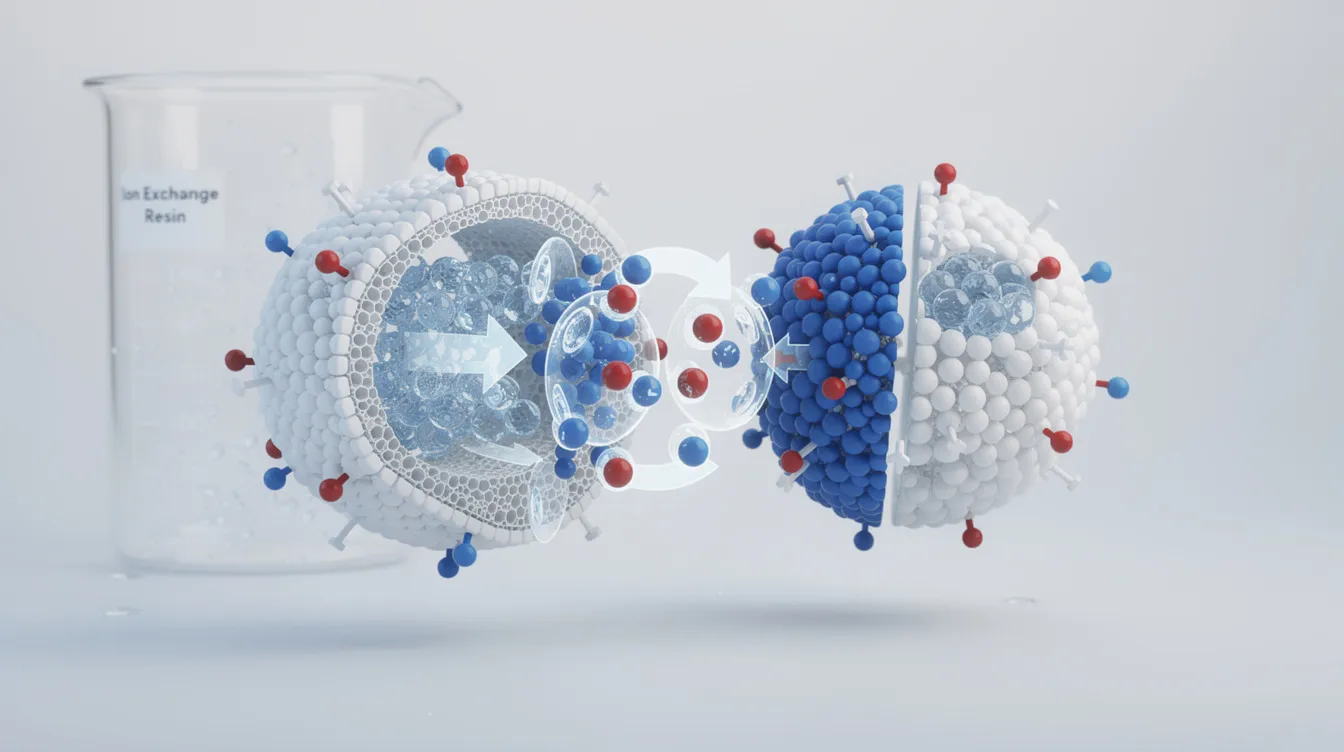
Ion exchange resin is a specialized polymer material that acts like a selective “sponge” to capture dissolved ions from liquids. This material plays a crucial role in water treatment. It facilitates the ion exchange process, a reversible chemical reaction where it removes unwanted dissolved ions and replaces them with others of similar charge. Think of it as a “swap station” for ions. It efficiently exchanges undesirable ions in water with more desirable ones to improve water quality.
Key Takeaways
- Ion exchange resins are versatile and customizable materials essential for targeted ion removal in water treatment.
- The resin’s polymer matrix and functional groups determine its selectivity and durability in various applications.
- Proper regeneration and maintenance are critical to sustaining resin performance and extending its service life.
- Specialty resins and macroporous structures enhance treatment options for specific contaminants and fouling resistance.
- Ion exchange technology supports a wide range of industries by enabling high-purity water production and contaminant control.
How Ion Exchange Resins Work
At the core of ion exchange resins is a polymer matrix embedded with functional groups that carry either positive or negative charges, depending on the type of resin. These functional groups serve as active sites where ion exchange reactions occur. When water containing dissolved ions passes through a bed of resin beads, the ions present in the water interact with the resin’s functional groups at those active sites, swapping places with ions attached to the resin. This process has four steps:
- Water enters the resin bed.
- Undesirable ions in the water bind to the resin’s functional groups.
- As the resin captures new ions, it releases its existing ions, such as sodium ions (Na⁺), hydrogen ions (H⁺), or hydroxide ions (OH⁻), into the water, keeping the exchange reversible. These materials act as ion exchangers in practical treatment systems, swapping captured contaminants for benign ions during service.
- Clean, treated water exits the system.
Physical Characteristics of Ion Exchange Resins
Ion exchange resins are composed of small, porous beads ranging from 0.25 to 1.43 millimeters in radius. They are usually white or yellowish in color. These beads consist of synthetic organic polymers forming an insoluble matrix that supports the functional groups responsible for ion exchange. The porous nature of the beads provides a large surface area, enhancing the efficiency of ion exchange reactions. The resin structure allows water and dissolved ions to penetrate the beads, facilitating rapid and effective ion exchange. Additionally, the beads are designed to be mechanically strong and chemically stable to withstand repeated regeneration cycles using chemicals like sulfuric acid or caustic solution. This durability ensures long service life and consistent performance in various ion exchange systems used for water treatment.
Types of Ion Exchange Resins
Ion exchange resins are broadly categorized based on the type of ions they exchange:
| Type | Exchanges | Common Use |
|---|---|---|
| Cationic resin | Positive ions (Ca²⁺, Mg²⁺) | Water softening, demineralization |
| Anionic resin | Negative ions (Cl⁻, NO₃⁻, SO₄²⁻) | Nitrate removal, dealkalization |
Cation Exchange Resins
Cation exchange resins specifically target positively charged ions, such as calcium ions (Ca²⁺), magnesium ions (Mg²⁺), and other hardness ions. These resins commonly contain sulfonic acid groups in a polystyrene matrix, which attract and hold these cations. Strong acid cation resins operate effectively across all pH ranges. They are widely used for water softening by exchanging hardness ions for sodium ions in the sodium form. Weak acid cation resins, on the other hand, are more selective for certain metals. They are often used in applications requiring dealkalization or partial demineralization. Both types of cation resins consist of ion exchange resin beads with exchange sites embedded in the resin matrix, enabling efficient capture and release of exchangeable ions.
Anion Exchange Resins
Anion exchange resins target negatively charged ions, or anions, such as chloride ions (Cl⁻), nitrate ions (NO₃⁻), sulfate ions (SO₄²⁻), and other dissolved salts. These resins typically feature quaternary ammonium groups attached to a polystyrene or acrylic polymer matrix, providing ion exchange sites with strong chemical resistance. Anion resins are classified as either strong base or weak base. Strong base anion resins maintain their negatively charged ion exchange sites across a wide pH range, enabling removal of a broad spectrum of anions including carbonic acid and organic contaminants. Weak base anion resins are more selective and often used to remove weakly ionized acids or protect strong base resins from fouling.
Specialty and Chelating Resins
Beyond standard cation and anion resins, specialty resins such as chelating resins are designed to selectively remove specific contaminants like heavy metals (e.g., arsenic, chromium) from water. These resins possess unique functional groups that form stable complexes with target ions, providing tailored solutions for challenging water treatment applications. Additionally, macroporous resins with larger pore sizes offer enhanced physical properties and resistance to organic fouling, making them suitable for removing organic contaminants alongside dissolved ions.
Resin Matrix and Physical Properties
Most ion exchange resins are based on a polystyrene matrix cross-linked with divinylbenzene, providing mechanical strength and chemical stability. Some resins use an acrylic polymer matrix, which increases resistance to organic contaminants and thermal degradation. The physical properties of ion exchange resin beads, including size, porosity, and resin capacity, influence the efficiency and selectivity of ion exchange processes. Proper selection of resin type and matrix ensures optimal performance tailored to specific water treatment goals.
Understanding the differences between anion exchange resins and cation exchange resins, as well as the distinctions between strong acid cation resins and weak acid cation resins, is essential for selecting the right ion exchange resin. This selection directly impacts the ability to remove dissolved ions effectively and produce high-quality treated water.
Applications of Ion Exchange Resins in Water Treatment
Ion exchange resins find extensive applications in water treatment, including:
- Drinking water purification by removing harmful dissolved ions to produce drinking water that meets safety standards.
- Water softening to eliminate hardness ions like calcium and magnesium ions, which cause scaling and reduce the efficiency of plumbing and machinery.
- Demineralization processes that produce high-purity and ultrapure water for industrial, laboratory, and electronics manufacturing uses.
- Treatment of industrial wastewater to remove nitrates, sulfates, heavy metals, and other ions, protecting the environment and enabling water reuse.
- Targeted removal of contaminants such as arsenic and chromium to ensure water safety and compliance with regulations.
- Food processing applications where ion exchange resins help remove unwanted ions, improving product quality and shelf life.
- Sugar manufacturing, where resins are used to decolorize and purify syrups, enhancing the final product.
Ion exchange resins also extend the life of water treatment systems by reducing total dissolved solids and preventing scaling through the exchange of undesirable ions with more desirable ions.
Benefits and Advantages of Ion Exchange Resins
Ion exchange resins provide numerous benefits that make them essential in water treatment applications, including:
- High efficiency in removing and exchanging ions from water
- Regenerable nature, allowing repeated use and reducing waste
- Environmentally friendly operation with minimal chemical usage
- Customizable to meet specific water quality and treatment goals
- Effective performance under a wide range of operating conditions
- Versatility for use in various industries and water treatment processes
- Reliability and long service life, ensuring consistent water quality
Ion Exchange Resin Regeneration Process
Over time, ion exchange resins become saturated with contaminant ions and lose their effectiveness. Regeneration is the process of stripping these contaminants from the resin and restoring the original regenerant ions, enabling the resin to be reused. The basic regeneration steps include:
- Flushing the resin with a regenerant solution such as sodium chloride (NaCl), hydrochloric acid (HCl), or sodium hydroxide (NaOH).
- Removing the bound contaminants from the resin.
- Restoring the resin’s ion exchange capacity for continued use.
Detailed Regeneration Steps
The regeneration process begins by passing a concentrated regenerant solution through the resin bed. For cation exchange resins, strong mineral acids like hydrochloric acid or sulfuric acid are commonly used to replace captured hardness ions with hydrogen ions. For anion exchange resins, sodium hydroxide in the hydroxide form is typically employed to displace unwanted anions and restore the resin’s capacity. In water softening applications, sodium chloride brine is used to regenerate the resin by replacing hardness ions such as calcium and magnesium with sodium ions.
As the regenerant solution flows through the resin, it dislodges the contaminant ions held within the resin’s functional groups, flushing them out of the system. This step effectively cleans the resin and prepares it for the next service cycle. It is important to optimize regenerant concentration and contact time to maximize efficiency while minimizing chemical consumption and resin wear.
Regeneration Efficiency and Resin Life
Each regeneration cycle slightly erodes the resin’s exchange sites, typically by about 0.5% to 2%, gradually reducing its capacity over time. Proper regeneration practices, including using the correct regenerant strength and thorough rinsing, help extend resin life and maintain consistent performance. Additionally, weak resins—such as weak acid cation resins and weak base anion resins—often require gentler regeneration conditions, which can improve their longevity and reduce chemical usage.
Considerations for Effective Regeneration
- Regenerant Selection: Choosing the appropriate regenerant depends on the resin type and application. Strong acid cation resins require strong mineral acids, while anion resins need strong bases like sodium hydroxide.
- Chemical Concentration: Using the optimal regenerant concentration prevents resin damage and reduces waste. Excessive concentrations can lead to resin degradation, while insufficient levels reduce regeneration effectiveness.
- Flow Rate and Contact Time: Controlled flow rates ensure adequate contact between regenerant and resin, promoting thorough ion exchange without channeling or incomplete regeneration.
- Temperature: Warmer regenerant solutions can improve regeneration efficiency but must be within resin temperature tolerance to avoid damage.
- Waste Management: Proper handling of spent regenerant solutions is essential to comply with environmental regulations and prevent contamination.
By understanding and carefully managing the ion exchange resin regeneration process, water treatment specialists can maximize resin performance, reduce operational costs, and maintain high water quality standards.
The Role of Ion Exchange Resins in Water Treatment
Ion exchange resins are essential materials in water treatment, offering efficient and customizable solutions to remove unwanted dissolved ions and improve water quality. Their reversible ion exchange process, physical robustness, and regenerability make them invaluable in applications ranging from drinking water purification to industrial wastewater treatment.
For tailored water treatment solutions, contact our team today to learn how we can help meet your specific needs.
Frequently Asked Questions (FAQs)
What is ion exchange resin used for in water treatment?
Ion exchange resins remove unwanted dissolved ions such as hardness ions, heavy metals, nitrates, and other contaminants from water. It improves water quality for applications like drinking water purification, water softening, demineralization, and ultrapure water production.
How does ion exchange resin work?
Ion exchange resin works through a reversible chemical process where the resin and the liquid exchange ions at the resin’s functional groups, with the ions present in the water swapping for the resin’s existing ions at those sites. This exchange removes undesirable ions from the water and replaces them with more acceptable ions.
What are the main types of ion exchange resins?
The main types are cation exchange resins, which exchange positively charged ions like calcium and magnesium, and anion exchange resins, which exchange negatively charged ions like chloride and sulfate. Specialty resins such as chelating and macroporous resins target specific contaminants.
How is ion exchange resin regenerated?
Regeneration involves flushing the resin with a concentrated chemical solution—such as sodium chloride brine, hydrochloric acid, or sodium hydroxide—to displace captured contaminants and restore the resin’s original exchange capacity for reuse.
What factors affect the lifespan of ion exchange resin?
The resin’s lifespan depends on factors including the quality of the influent water, frequency and quality of regeneration, exposure to oxidizing agents like chlorine, fouling by organic or inorganic materials, and mechanical wear during operation.
Can ion exchange resin produce ultrapure water?
Yes, ion exchange resins are used in ultrapure water production by removing nearly all dissolved ions. This high purity water is critical for applications such as electronics manufacturing and laboratory processes.
What are the advantages of using ion exchange resins?
Advantages include high efficiency in ion removal, regenerability for repeated use, adaptability to different water chemistries, environmentally friendly operation with minimal chemical waste, and the ability to produce water of varying purity levels.
Are there any limitations to ion exchange resin use?
Limitations include sensitivity to fouling from organics and metals, gradual loss of exchange capacity with repeated regeneration, the need for pretreatment to remove suspended solids, and the production of waste regenerant solutions requiring proper disposal.
