
Water is both a fundamental ingredient and an essential resource for utility in beverage production. Its quality directly influences the beverage, by impacting taste, safety, consistent product quality, shelf life, and compliance with regulatory requirements.
Understanding the nuances of water quality control in beverage production is crucial for ensuring food safety and producing high-quality beverages. While potable water standards provide a baseline, the beverage industry often demands stricter standards to meet consumer expectations and maintain brand reputation.
Key Takeaways
- Water quality is a foundational element that influences beverage safety, flavor, and consistency throughout production.
- A combination of physical, chemical, microbiological, and sensory evaluations is necessary to ensure high-quality water for beverages.
- Maintaining microbial control through hygienic design and sanitation is essential to prevent contamination and extend product shelf life.
- Detailed documentation and supplier management support traceability, compliance, and continuous quality improvement.
- Employee training and proactive corrective actions are critical components to uphold water quality standards in beverage production.
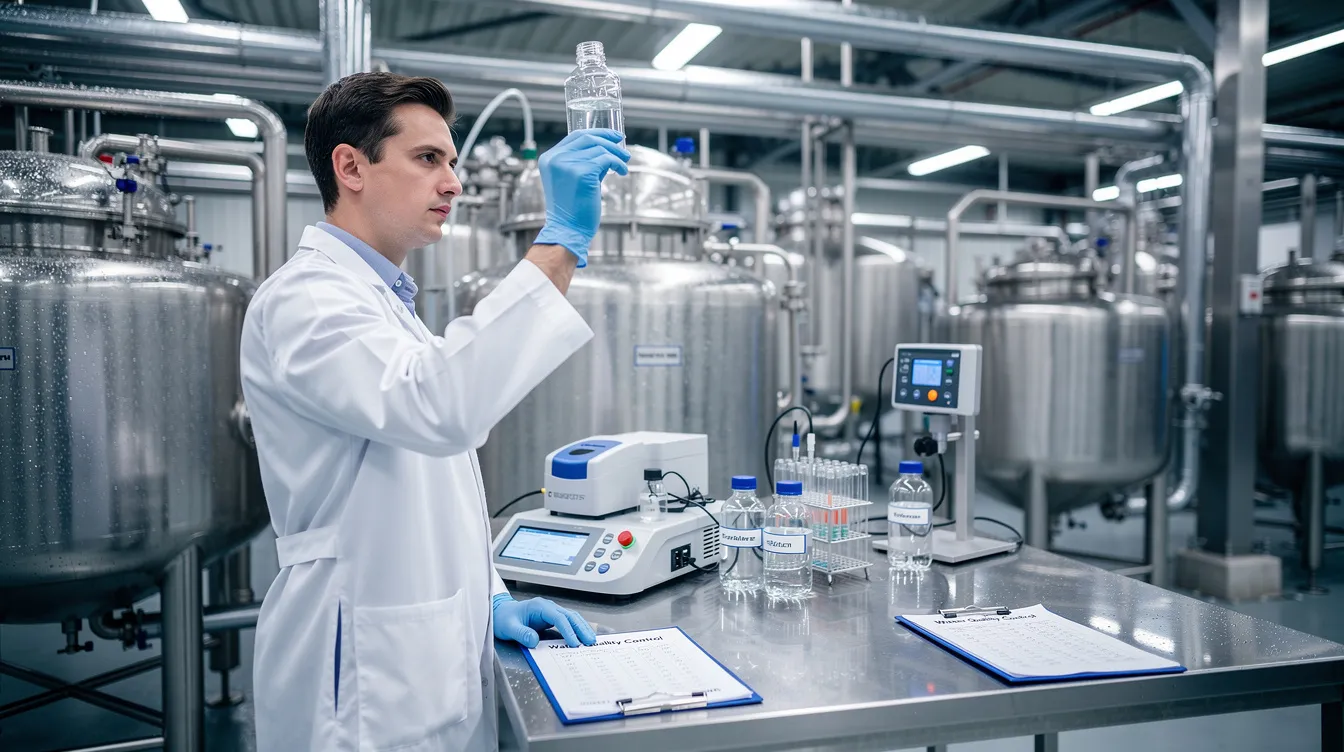
Water Quality and Its Critical Role in Beverage Production
Water serves multiple purposes in the beverage production process:
- Ingredient water is used in the formulation, dilution, brewing, extraction, or blending of beverages.
- Process water is used for rinsing, washing, product contact, and cleaning.
- Utility water is used in boilers, cooling systems, and non-product-contact operations.
Among these, ingredient and product-contact water require strict quality control to ensure safety and consistency in finished products. Poor water quality can lead to off-flavors, haze, instability, scale buildup, corrosion, and increased microbial risk, all of which impact beverage quality and customer satisfaction.
To ensure compliance with regulatory bodies and industry best practices, specifications must be clearly defined based on source water, beverage type, and process application. Implementing proper water treatment and monitoring protocols, including effective monitoring procedures, is essential to maintain product safety, nutritional labeling accuracy, and packaging materials integrity throughout the supply chain.
Essential Water Quality Parameters for Beverage Production
In beverage quality control, monitoring specific water quality parameters is crucial to ensure the safety, consistency, and sensory appeal of the final product. These parameters include physical, chemical, microbiological, and sensory factors that collectively influence beverage quality and regulatory compliance.
Key physical parameters such as turbidity, color, temperature, suspended solids, odor, and clarity provide initial indicators of water quality. Elevated turbidity or particulates may signal filter failure, changes in source water, or inadequate distribution system control. Maintaining optimal levels helps prevent contamination risks and protects equipment from damage.
Chemical analysis focuses on parameters like pH, total dissolved solids (TDS), conductivity, alkalinity, hardness, residual chlorine or chloramine, iron, manganese, nitrates, and total organic carbon (TOC). These factors affect beverage formulation, taste, membrane filtration performance, scale formation, corrosion, and disinfection efficiency. Regular chemical tests are vital to maintain food safety and ensure compliance with regulatory guidelines.
Microbiological testing methods, including total plate count, coliforms, E. coli, yeast and mold, Pseudomonas, biofilm indicators, and advanced techniques like polymerase chain reaction (PCR), are essential to identify contamination risks. Microbial growth can originate from source water, storage tanks, dead legs in piping, carbon filters, hoses, or lapses in sanitation protocols. Effective microbiological control safeguards consumer health and product shelf life.
Sensory evaluation assesses taste neutrality, odor control, mineral balance, chlorine removal, and off-flavor prevention. These parameters are critical to meet customer expectations and maintain consistent food quality. Sensory testing complements laboratory testing methods to verify that water quality supports the desired final product characteristics.
By systematically monitoring these water quality parameters, beverage manufacturers can implement critical control points, maintain compliance with industry standards, and uphold rigorous quality control practices that protect both consumer safety and brand reputation.
Beverage Production Water Testing
Effective water testing and monitoring ensure that water used throughout production meets safety and quality standards. Establishing comprehensive sampling points and adopting a risk-based monitoring approach helps beverage manufacturers ensure consistency, verify compliance, and address safety concerns proactively.
To capture valuable data and identify trends, teams should collect samples systematically at critical points in the production process under a documented sampling plan, including:
- Raw water inlet
- Pre-filtration outlet
- Carbon filter outlet
- Softener outlet
- Reverse Osmosis (RO) permeate
- Ultraviolet (UV) treatment outlet
- Storage tank outlet
- Distribution loop return
- Point of use
- Finished product water
Collecting samples at these stages allows for early detection of quality issues, supports hazard analysis, and helps maintain packaging integrity and product consistency.
Beverage Quality Control Monitoring Strategies
A combination of online monitoring, laboratory testing, and event-based testing forms a robust beverage quality control program:
- Online Monitoring: Continuous measurement of parameters such as pH, conductivity, turbidity, flow, pressure, chlorine levels, and UV intensity provides real-time insights into water quality. This data collection, including tracking KPIs like temperature and pressure, helps identify potential issues early and supports corrective action to minimize human error.
- Laboratory Testing: Regular laboratory analyses include microbial counts, coliforms, yeast and mold, total organic carbon (TOC), metals, and comprehensive chemical profiles. These tests verify compliance with regulatory guidelines and good manufacturing practices (GMP), ensuring food safety and high-quality ingredients.
- Event-Based Testing: Conduct additional testing following maintenance activities, sanitation failures, source water changes, treatment alarms, or suspected contamination events. This approach supports early detection and corrective actions, fostering continuous improvement and customer trust.
Tailor testing frequency based on risk factors such as source water variability, product sensitivity, regulatory expectations, and historical plant data. Implementing specific guidelines for sampling and testing schedules ensures that food safety audits are effective. Regular testing and audits help identify issues before products reach consumers using criteria such as taste, appearance, packaging integrity, and shelf life, so the beverage production process consistently delivers safe, high-quality products.
Water Treatment Techniques in Beverage Quality Control
Proper water treatment is essential to guarantee that raw materials comply with strict standards and support the production of safe, consistent food and beverage products. Implementing a combination of treatment methods helps control physical hazards, chemical contaminants, and microbial risks, safeguarding both product quality and consumer safety.
Pre-filtration
- Utilizes sediment filtration, multimedia filtration, and cartridge filters to remove particulates and suspended solids.
- Protects downstream equipment from damage and fouling, enhancing system longevity.
- Essential for maintaining consistent raw material sourcing quality and preventing physical hazards.
Activated Carbon Filtration
- Reduces chlorine and chloramine levels, improving taste and odor to meet consumer expectations.
- Removes organic compounds that can affect beverage flavor and stability.
- Requires regular microbial monitoring since carbon beds can harbor biological growth if not properly maintained.
Softening and Hardness Control
- Targets calcium and magnesium reduction to prevent scale buildup.
- Protects boilers and membrane systems, ensuring operational efficiency.
- Can influence sodium content and final mineral profile, impacting beverage formulation.
Reverse Osmosis (RO)
- Significantly lowers total dissolved solids (TDS) to maintain mineral consistency and beverage quality.
- Reduces a broad spectrum of contaminants, supporting regulatory compliance.
- Requires monitoring of membrane fouling, pressure, flow, recovery rates, and conductivity.
- Remineralization may be necessary depending on the beverage type to achieve desired taste and nutritional labeling accuracy.
Ultraviolet (UV) Disinfection
- Provides microbial inactivation as a non-chemical control step.
- Installed after filtration to maximize effectiveness.
- Performance depends on UV intensity, water transmittance, lamp condition, and sleeve cleanliness.
Final Polishing
- Involves point-of-use filtration with sanitary filter housings.
- Employs sterile-grade filtration where required to ensure product safety.
- Regular filter replacement and integrity testing are critical to maintaining consistent water quality.
By integrating these water treatment methods within a comprehensive beverage quality control program, manufacturers can ensure raw materials meet the highest standards, supporting safe, high-quality consumer products in a competitive market.
Microbial Control and Compliance with HACCP and GMP Standards
Managing microbial risks is critical to ensure product safety and maintain consumer trust. Key microbial hazards often arise from biofilms in distribution loops, stagnant water, dead legs, poorly sanitized tanks, carbon filter colonization, contaminated hoses and fittings, and post-treatment contamination. These risks can compromise beverage quality and pose health concerns if not properly controlled.
Effective microbial control relies on hygienic piping design that minimizes areas prone to microbial growth, combined with regular sanitation procedures and thorough storage tank inspections. Loop recirculation helps prevent stagnation, while validated disinfection protocols ensure microbial populations are kept within safe limits. Incorporating sanitary sampling points allows for accurate monitoring of microbial levels throughout the system. When deviations occur, implementing corrective action procedures promptly addresses contamination and prevents recurrence.
Beverage water quality programs follow HACCP principles by setting critical limits, keeping monitoring records, and documenting corrective actions. Maintaining audit-ready documentation, such as SOPs, sampling plans, calibration logs, sanitation records, treatment data, microbiological test results, and corrective actions, supports regulatory compliance and continuous improvement. Supplier management includes vetting suppliers, keeping traceability records, and choosing partners with a proven track record. Regular supplier audits help identify issues early before they impact the final product.
By integrating these microbial control measures and maintaining comprehensive records, beverage producers can safeguard product safety, support regulatory compliance, and enhance overall beverage quality control within the food industry through ongoing review of QC data, employee feedback, and customer complaints.
Frequently Asked Questions (FAQs)
What are the most important water quality parameters in beverage production?
Key water quality parameters include pH, total dissolved solids (TDS), conductivity, turbidity, hardness, residual disinfectant levels (such as chlorine or chloramine), total organic carbon (TOC), and microbial indicators like total plate count and coliform bacteria. Monitoring these ensures safety, taste consistency, and regulatory compliance.
Why is reverse osmosis used in beverage production?
Reverse osmosis (RO) is used to control TDS, ensuring mineral consistency and reducing a wide range of contaminants. RO supports product stability and helps meet stringent regulatory standards by producing high-purity water essential for many beverage types.
How does UV disinfection support beverage water quality?
UV disinfection provides effective microbial control through non-chemical means by inactivating pathogens. Its effectiveness depends on maintaining proper UV intensity, water transmittance, lamp condition, and cleanliness of quartz sleeves, which must be regularly monitored.
How often should beverage production water be tested?
Testing frequency should be risk-based, incorporating continuous online monitoring for critical parameters, routine laboratory testing at scheduled intervals, and event-based testing after maintenance, sanitation failures, or suspected contamination to ensure early detection and corrective action.
What role does microbial control play in beverage quality?
Microbial control prevents contamination from biofilms, stagnant water, and poorly sanitized equipment. It is essential for consumer safety, product shelf life, and compliance with HACCP and GMP standards, requiring regular sanitation, hygienic design, and validated disinfection protocols.
How important is documentation in beverage quality control?
Accurate records, including SOPs, sampling logs, calibration data, sanitation reports, and corrective actions, are critical for regulatory compliance, traceability, and continuous improvement in beverage quality control programs.
What water treatment methods are commonly used in beverage production?
Common methods include pre-filtration, activated carbon filtration, softening, reverse osmosis, ultraviolet disinfection, and final polishing with sterile filtration. These combine to remove physical, chemical, and microbial contaminants, ensuring product safety and quality.
How does water quality affect beverage taste and shelf life?
Water quality impacts flavor, odor, clarity, and stability. Contaminants or imbalanced minerals can cause off-flavors, haze, or spoilage, reducing shelf life and consumer satisfaction. Maintaining optimal water quality is essential for consistent, high-quality beverages. Over time, consumer feedback on taste and overall acceptability can help refine water treatment targets and sensory expectations.
What are critical control points (CCPs) in water quality management?
CCPs are specific stages in the water treatment and beverage production process where control measures are applied to prevent or eliminate hazards. Monitoring these points helps maintain safety and quality throughout production.
Why is employee training important in water quality control?
Employee training ensures staff understand water quality standards, testing procedures, sanitation protocols, and corrective actions, fostering consistent implementation of quality control measures and reducing risks of contamination or process errors.
