
Legionella testing is a critical component in managing water safety and preventing outbreaks of Legionnaires’ disease. This article aims to guide through recommended testing cadences, priorities, and core test methods to help effectively detect and control Legionella bacteria in various water systems.
Key Takeaways
- Legionella bacteria flourish in warm, stagnant water, making temperature control and regular system maintenance essential.
- Multiple testing methods, including culture, qPCR, and Legiolert, provide complementary insights for effective monitoring.
- Testing frequency should align with facility risk levels and increase after remediation or during outbreak investigations.
- Accurate interpretation of test results guides timely interventions to prevent Legionnaires’ disease outbreaks.
- Collaboration with accredited laboratories and integration of testing into water management programs enhance overall water safety.
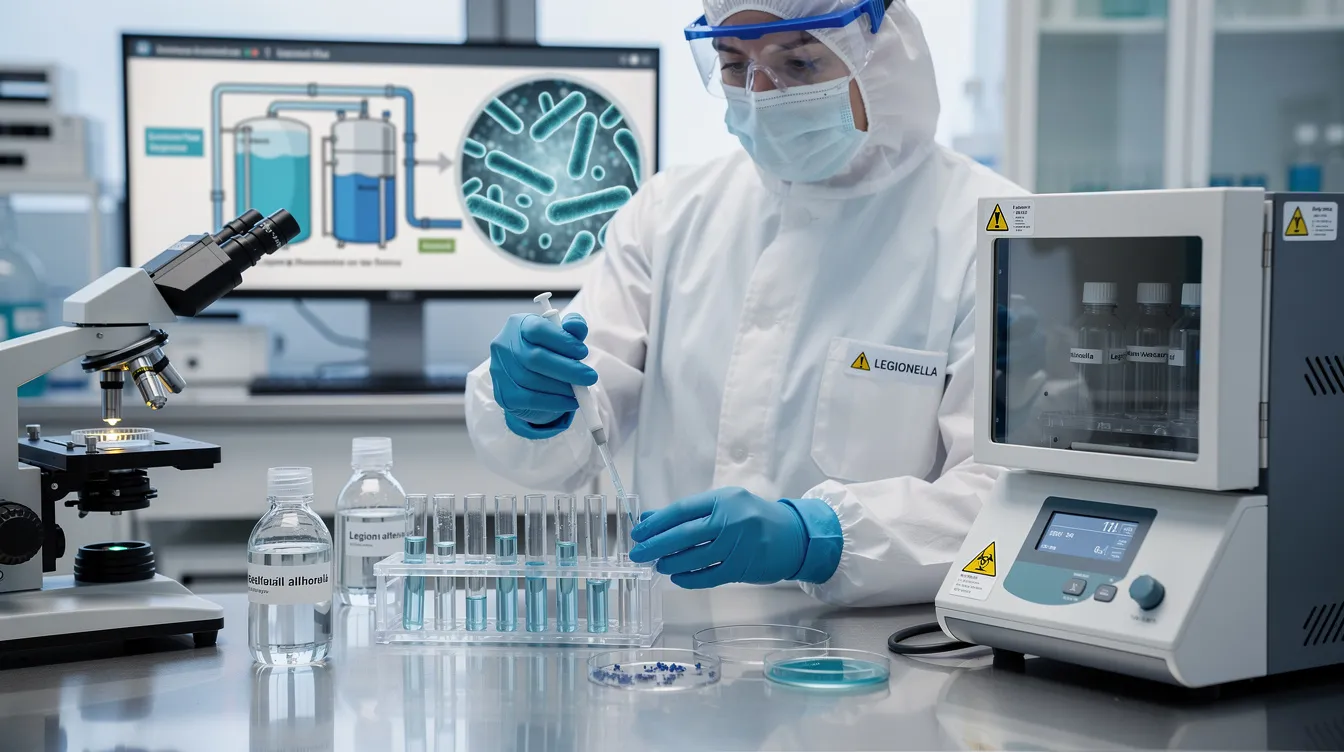
Background: Legionella Bacteria, Pneumophila, and Health Risk
Legionella bacteria are naturally occurring microorganisms found in freshwater environments. Among these, Legionella pneumophila is the most significant species due to its association with Legionnaires’ disease, which is a severe form of pneumonia. Exposure to contaminated water aerosols containing Legionella can lead to infection, especially in vulnerable populations. These bacteria thrive in warm water environments such as plumbing systems, cooling towers, hot tubs, and evaporative condensers.
Public Health Triggers and When To Run a Legionella Test
Testing for Legionella is often prompted by public health reporting triggers, routine monitoring needs, or event-driven scenarios such as outbreaks or building re-openings. Routine testing is essential in facilities with water management programs, especially those with complex plumbing systems or high-risk populations. On the other hand, event-driven testing is critical during suspected outbreaks of Legionnaires’ disease to identify contamination sources and prevent further spread. It becomes especially urgent after suspected exposure because symptoms can appear 2 to 14 days later.
Test Methods and Test Method Selection for Legionella pneumophila
Selecting the appropriate test method depends on the testing objective, whether for routine monitoring, outbreak investigation, or clinical diagnosis.
Culture (ISO/CDC) Test Method
Culture methods remain the gold standard for isolating Legionella species from water samples. They are typically performed by a specialized lab and require a turnaround time of about 7 to 10 days, while helping determine viable contamination levels. Culture remains useful even when other methods are used for faster screening or confirmation. Pairing culture with molecular methods enhances detection accuracy and helps confirm3 viable bacterial growth.
qPCR and vPCR Test Method
Quantitative PCR (qPCR) offers rapid detection of Legionella DNA within 1 to 2 days, providing a quick turnaround time. Viability PCR (vPCR) further distinguishes between viable and nonviable bacteria, although qPCR may detect DNA from nonviable cells, which can affect result interpretation.
Legiolert Test Method
Legiolert is a culture-based enzymatic assay designed specifically to detect Legionella pneumophila. It has an incubation time of approximately 7 days and is useful for routine monitoring of potable and non-potable water sources.
Urinary Antigen Test and Clinical Diagnostics
The Urinary Antigen Test (UAT) is a common diagnostic test used in clinical settings to detect Legionella pneumophila serogroup 1 in patients. Urine testing is widely used because a urine sample is non-invasive in clinical diagnosis. In addition to urinary antigen testing, diagnosis may also involve a sputum sample and sputum culture depending on the case. Linking environmental testing results with clinical isolates through culture methods aids in outbreak investigations and source identification. In severe or complex cases, confirming legionella infection may also require testing lung tissue, and L pneumophila serogroup 1 testing does not capture other forms.
Sampling Strategy and Routine Testing Frequency
An environmental assessment should be conducted to identify risk points within the water system. Sampling should target critical locations such as cooling towers, hot water loops, and points prone to bacterial growth. Routine testing frequency can be tiered based on risk levels, with a typical recommendation of at least every six months. Sample volumes are generally 250 mL, with water samples collected following standardized protocols to ensure accuracy.
Special Systems: Cooling Towers, Cruise Ships, and High-Risk Facilities
Cooling towers, evaporative condensers, and fountains are high-risk systems due to their potential to generate contaminated water aerosols. Cruise ships require specific sampling cadences given their unique water systems and passenger populations. Healthcare and aged care facilities necessitate enhanced testing frequencies and stringent controls due to vulnerable occupants.
Laboratory Selection and Quality Considerations
Selecting laboratories accredited to ISO/IEC 17025 or equivalent international organizations assures quality and reliability. Laboratories should provide detailed test method performance characteristics, retain samples and isolates for further analysis, and offer clear turnaround times and reporting formats. They should also provide guidance and additional information on sample collection, method selection, and result interpretation when needed.
Interpreting Test Results and Recommended Actions
Test results typically report Legionella levels in colony forming units (cfu) per litre. For qPCR, results are expressed in genomic units. Action thresholds include:
- Less than 100 cfu/l: No immediate action, but continued monitoring.
- Between 100 and 1,000 cfu/l: Low-level contamination requiring investigation and possible review of control measures.
- Greater than 1,000 cfu/l: High-level contamination necessitating immediate remedial action and disinfection.
Following positive detection, immediate control measures should be implemented, and retesting conducted after remediation to confirm effectiveness.
Control Measures and Integration Into Water Safety
Immediate control measures include flushing, disinfection, and isolation of contaminated sections. Engineering controls such as temperature regulation and biocide application are vital in cooling towers. Operational controls on cruise ships and other systems should be integrated within a comprehensive water management program to mitigate Legionella growth and spread.
Outbreak Investigation and Linking to Legionella Pneumophila Causing Pneumonia
During an outbreak of Legionnaires disease, sputum samples or bronchoalveolar lavage may be collected so clinical isolates can be matched to environmental isolates using culture methods. Clinicians also assess symptoms and may distinguish Legionnaires’ disease from pontiac fever, a flu like illness caused by Legionella. Prompt notification of public health authorities and enhanced environmental sampling are essential for outbreak control and prevention.
Reporting, Recordkeeping, and Regulatory Compliance
All test results, control measures, sampling records, and remediation actions should be thoroughly documented. Maintaining records supports regulatory compliance and facilitates audits. Practices should align with local public health requirements and international guidelines.
Summary and Essential Recommendations
Water treatment specialists should prioritize routine Legionella testing using a combination of culture, qPCR, and Legiolert methods, tailored to the facility’s risk profile, with prompt diagnosis and antibiotics critical when testing supports confirmed disease. Regular environmental assessments and adherence to testing frequency recommendations enhance early detection. Integrating testing results into water management programs ensures effective control of Legionella growth, protecting public health and preventing outbreaks of Legionnaires’ disease.
For inquiries on Legionella testing services, contact our team today.
Frequently Asked Questions (FAQs)
What is Legionella testing and why is it important?
Legionella testing involves analyzing water samples to detect the presence of Legionella bacteria, particularly Legionella pneumophila. It is crucial for preventing outbreaks of Legionnaires’ disease by identifying contamination early and ensuring water safety in buildings and systems.
How often should Legionella testing be performed?
Routine Legionella testing is typically recommended at least every six months, especially in high-risk facilities such as healthcare settings, cooling towers, and cruise ships. Testing frequency may increase based on risk assessments or following remediation efforts.
What are the main methods used for Legionella testing?
Common testing methods include culture-based tests (ISO/CDC), which are the gold standard, rapid molecular methods like qPCR, and enzymatic assays such as Legiolert. Clinical diagnostic tests include urinary antigen and sputum tests for suspected infections.
How are Legionella test results interpreted?
Results are usually reported in colony-forming units per litre (cfu/l). Levels below 100 cfu/l generally require no immediate action, 100-1,000 cfu/l indicate low-level contamination needing investigation, and levels above 1,000 cfu/l demand immediate remedial action and disinfection.
What actions should be taken if Legionella is detected in water systems?
If Legionella is detected, control measures such as flushing, disinfection, and system isolation should be implemented promptly. A review of the water management program is necessary, followed by retesting to confirm remediation success.
Can Legionella testing detect all species of Legionella bacteria?
While most tests focus on Legionella pneumophila, some methods can detect other species. Culture methods and molecular testing can identify a broader range of Legionella species, which is important for comprehensive risk assessment.
How does Legionella testing relate to clinical diagnosis of Legionnaires’ disease?
Clinical diagnostic testing, including urinary antigen and sputum cultures, helps confirm Legionnaires’ disease in patients. Linking clinical isolates with environmental Legionella through culture testing aids outbreak investigations and source identification.
What role do laboratories play in Legionella testing?
Accredited laboratories ensure reliable and accurate Legionella testing. They provide detailed performance data, retain samples for further analysis, and assist with interpreting results to support effective water management decisions.
