
Creating a Water Management Plan for Legionella Control requires a clear focus on the facility’s scope, emphasizing Legionella prevention. The plan should begin by summarizing objectives aimed at preventing Legionella growth and spread, highlighting the importance of a comprehensive water management program tailored to the facility’s needs.
Key Takeaways
- Establishing a multidisciplinary team is essential for effective Legionella risk management.
- Mapping water systems helps pinpoint critical control points and potential hazards.
- Setting measurable control limits and monitoring protocols ensures ongoing water safety.
- Regular training and clear communication enhance program adherence and responsiveness.
- Continuous evaluation and documentation support compliance and program improvement.
Key Principles of Legionella Water Management
An effective water management program starts with hazard identification, specifically addressing Legionella bacteria and biofilm formation as critical risk factors. Establishing control limits is essential. These include maintaining appropriate temperature ranges, disinfectant residual levels, and cycles of concentration in cooling towers to inhibit bacterial growth. Verification of control measures ensures that these parameters effectively reduce Legionella risk, while validation through routine Legionella testing and monitoring confirms the program’s success. Thorough documentation of all the activities related to Legionella control supports transparency and continuous review.
When to Deploy Legionella Water Management Plans
Legionella-specific water management plans should be developed when certain triggers occur, such as the age of a building, previous Legionella outbreaks, or the presence of high-risk populations. Facilities with complex water systems or those housing vulnerable residents, like hospitals and long-term care facilities, require a full water management program. Priority should be given to managing devices that aerosolize water and promote Legionella growth, including cooling towers, showers, spas, and humidifiers.
Building Factors Affecting Legionella Water Management Plans
Several building factors influence Legionella risk and the design of water management plans. Older buildings with complex plumbing systems often present higher risks. Occupancy types and patient-risk areas, such as hospitals and long-term care facilities with high-risk care areas for patients, demand special consideration. Regulatory constraints, including anti-scald regulations, may impact temperature control strategies (e.g. a building with distal mixing valves may require different control choices). This necessitates tailored approaches to maintain safety while preventing bacterial growth over time and under local conditions.
Create the Legionella Water Management Team
A designated team is vital to help establish an effective Legionella water management program. This team should include an accountable executive with authority to allocate resources and report to the organization’s leadership for oversight, a facilities lead knowledgeable about building water systems and Legionella risks, and an infection prevention expert familiar with Legionella transmission and control methods. These members are expected to understand the building water systems and their roles. The team’s ability to act depends on clear accountability and sufficient resources. Regular team meetings focused on Legionella water management activities provide support and helpful oversight for implementation, ensuring coordinated efforts and timely responses.
Map the Water System and Legionella Control Locations
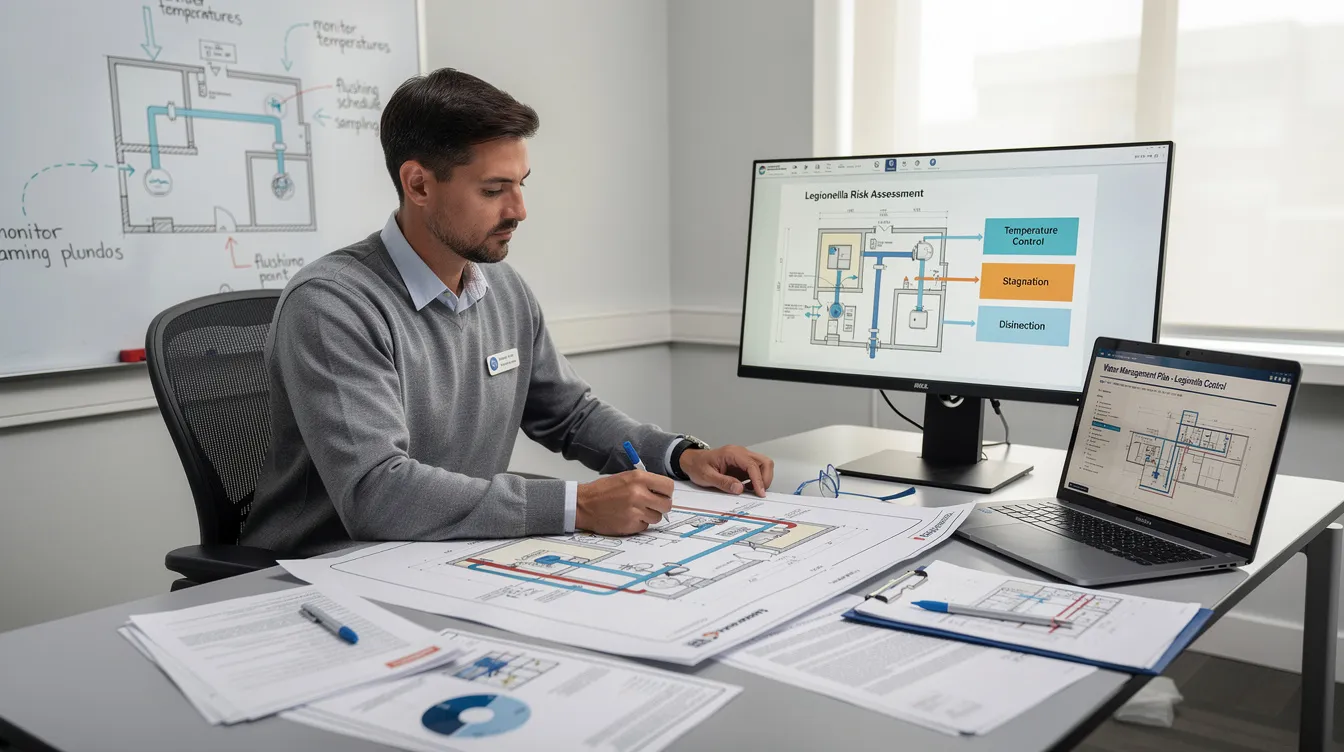
Developing a simplified water system flow diagram helps identify potential Legionella hazard points. This map should provide an overview of the site water system and highlight aerosolization sources such as cooling towers, spas, and humidifiers, as well as hot and cold water endpoints prone to bacterial growth. A multidisciplinary team tour of the facility helps the team learn how water moves through the site and supports effective plan design.
Cooling Towers and Other High-Risk Equipment for Legionella
Cooling towers require particular attention. It’s critical to assess their cycles of concentration, measuring blowdown rates, and monitoring biocide residuals to minimize Legionella growth. Meticulously document maintenance records focused on Legionella prevention to support continuous review and program effectiveness.
Design the Legionella Water Management Plan
To effectively design a Legionella water management plan, the team should focus on the following key steps:
- Define control locations critical for Legionella risk mitigation using the water system map.
- Set both short-term and long-term goals for control measures.
- Establish measurable control limits for parameters such as temperature, disinfectant residual, and cycles of concentration.
- Select and implement control measures including disinfection, flushing, and temperature regulation through clear, actionable steps.
- Align the plan design with ANSI/ASHRAE Standard 188-2018 risk-management principles.
- Specify monitoring frequency and methods targeting Legionella hazards.
- Document corrective actions for any excursions beyond established control limits.
Develop Legionella-Specific Procedures and Maintenance Protocols
Organize detailed procedures as a series of clear steps for monitoring Legionella control parameters. Develop routine maintenance protocols aimed at preventing bacterial growth and spread, which address hazardous conditions. These should also include action plans for unusual disruptions such as drought-related operating changes, with documentation templates standardized for all control tasks. Vendor qualifications for chemical treatments targeting Legionella should be required to ensure effectiveness and safety, with procedures covering other waterborne pathogens where relevant.
Monitoring, Verification, and Validation for Legionella Control
Selecting appropriate laboratory testing methods, including culture and DNA-based techniques, is critical for detecting Legionella and helping confirm control limits are met. Sampling should focus on high-risk locations with schedules for routine testing. As a general framework, monitoring tracks day-to-day conditions, verification checks that the program is being followed through audits, and validation compares control measures against test results to ensure the program’s integrity. Clear trigger thresholds must be defined to escalate remediation efforts when necessary.
Laboratory Testing and Response Actions for Legionella
Accredited laboratories should perform Legionella testing, following strict chain-of-custody procedures for sample handling. Immediate response protocols must be in place for positive findings, including remedial disinfection and follow-up testing. Documentation of all response actions supports regulatory compliance and continuous improvement.
Training, Communication, and Documentation for Legionella Control
Role-specific training modules educate staff on Legionella risks and control practices. Incident communication templates facilitate timely and effective information sharing during Legionella events. Records retention policies ensure documentation of control activities is maintained for the required periods. Specialized training on high-risk equipment like cooling towers enhances safety and program effectiveness.
Auditing, Continuous Improvement, and Review of Legionella Program
Periodic internal audits focused on Legionella program compliance help identify gaps and opportunities for improvement. Annual risk reassessments ensure the plan remains current with building changes and emerging risks. Updates should follow any water system modifications or Legionella cases. Tracking performance metrics related to control effectiveness supports data-driven decision-making.
Implementation Checklist and Templates for Legionella Control
Providing downloadable templates for Legionella water management plans, monitoring logs, and corrective-action checklists, along with a related resource article readers can download from the site, supports organizations in implementing and maintaining effective programs. These resources serve as practical tools to streamline documentation and compliance efforts. EPA has implemented 10 water management techniques that facilities can use as examples in a well-structured water management program to improve efficiency and reduce waste in water usage.
Templates and checklists can also include:
- fixtures designed to reduce toilet water use to 1.28 gallons per flush (gpf),
- systems for recovering rainwater to supply toilets and cooling towers, water audits that help reduce landscape water use by 10 to 20 percent,
- and controls for steam sterilizers to prevent unnecessary water discharge.
Regulatory Alignment and Reporting for Legionella
Aligning the water management plan with standards such as ASHRAE Standard 188 and local Legionella regulations ensures compliance. The plan must define reporting obligations to health authorities for Legionella cases and document evidence of compliance for inspections and audits. This regulatory alignment supports organizational safety and public health goals.
By following this multi-step process and maintaining continuous review, organizations can implement an effective document that supports Legionella control, enhances safety, and reduces the risk posed by waterborne pathogens in their facilities.
For inquiries on Legionella testing, contact our team today.
Frequently Asked Questions (FAQs)
What is a water management plan and why is it important for Legionella control?
A water management plan is a documented strategy that outlines procedures to prevent and control the growth and spread of Legionella bacteria within a facility’s water systems. It is crucial for Legionella control because it identifies risk areas, sets control measures, monitors water quality, and ensures compliance with health standards to protect occupants.
Who should be part of the designated team for a Legionella water management plan?
The designated team should include an accountable executive with authority to allocate resources, a facilities manager knowledgeable about building water systems, and an infection prevention expert familiar with Legionella risks and control methods. Additional members may include nursing management, environmental safety personnel, and representatives from affected areas.
How often should a water management plan be reviewed and updated?
A water management plan requires continuous review to ensure its effectiveness. Periodic reviews, at least annually or after significant changes to the water system or following Legionella cases, help update risk assessments, procedures, and control measures based on current conditions and regulations.
What are common control measures used in Legionella water management plans?
Common control measures include maintaining water temperatures outside Legionella growth ranges, ensuring disinfectant residuals are adequate, flushing stagnant water, cleaning and maintaining cooling towers, and using biocides. These measures help control biofilm and bacterial growth in the water system.
How does laboratory testing support Legionella control in a water management plan?
Laboratory testing, using culture or DNA-based methods, validates the effectiveness of control measures by detecting Legionella presence in water samples. Testing focuses on high-risk locations and helps trigger corrective actions when positive results occur, supporting continuous validation of the water management program.
