
Proper hazardous chemical storage is an essential part of maintaining safety and compliance in water treatment facilities. These facilities often involve plant operations, laboratories, tanks, and maintenance shops, all of which require careful handling and storage of various hazardous substances and process chemicals. This article provides a comprehensive guide to understanding and implementing best practices for hazardous chemical storage.
Key Takeaways
- Proper hazardous chemical storage is critical to ensure safety and regulatory compliance in water treatment facilities.
- Use approved flammable storage cabinets and limit quantities stored outside to reduce fire risks.
- Implement secondary containment systems to prevent spills from spreading and protect the environment.
- Segregate incompatible chemicals based on hazard class to avoid dangerous reactions.
- Maintain clear labeling and accessible Safety Data Sheets for all chemicals and containers.
- Train employees thoroughly on chemical hazards, storage practices, and emergency response procedures.
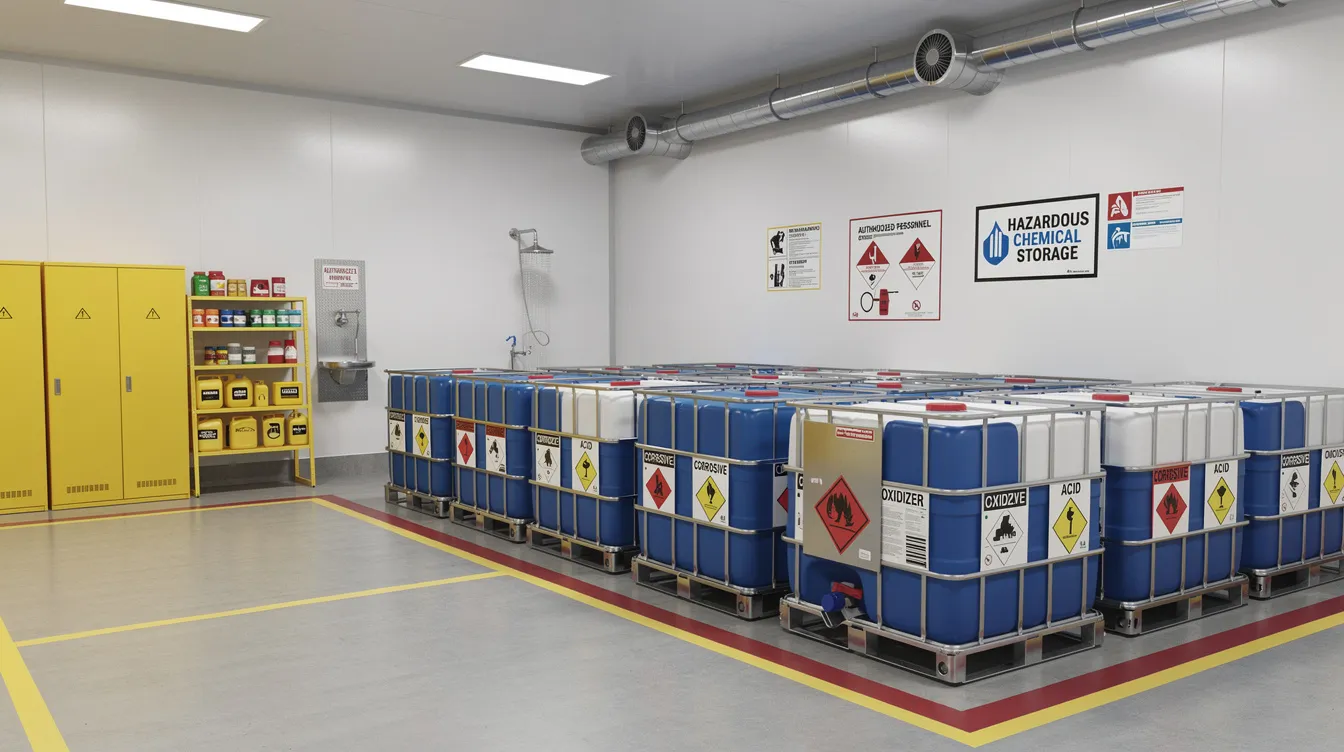
Regulatory and Standards Overview for Hazardous Materials
Water treatment facilities must comply with multiple regulatory standards. OSHA sets the baseline for chemical storage safety, including requirements for employee training, labeling, and safe handling. They define hazardous chemicals as those that present physical or health hazards. They also require a written hazard communication program covering chemical storage, labeling, and employee access to hazard information.
The NFPA provides rules focused on fire prevention and the safe storage of flammable or combustible liquids. Additionally, EPA regulations mandate secondary containment measures to protect the environment from accidental releases. It is also essential to check state and local fire codes, which may impose specific requirements and additional requirements beyond federal standards.
Site Assessment and Chemical Inventory
A thorough site assessment begins with conducting a detailed chemical inventory by location. This involves collecting and indexing Safety Data Sheets (SDS) for every product stored or used on site. Mapping all storage locations and their designated functions helps determine space needs and identify potential risks. Quantifying flammable liquids and other high-risk stocks ensures compliance with storage limits and informs the design of storage areas.
Storage Area Design and Safe Storage Practices
When designing hazardous chemical storage areas, consider the following key features to ensure safety and compliance:
- Designate secure storage areas exclusively for hazardous chemicals, sized to limit aggregated inventory.
- Provide mechanical ventilation where vapors could accumulate to reduce toxic gas buildup and fire hazards.
- Use cabinets with ventilation connections under fume hoods when handling volatile corrosives.
- Install locks and access controls to restrict entry to authorized personnel only.
- Display clear signage and hazard pictograms in storage areas.
- Ensure the floor is sealed and chemically resistant.
- Store hazardous liquids below eye level to minimize splash risks during handling.
- Physically separate storage areas from process zones and drains to prevent contamination.
- Employ site layout controls such as slopes and curbs to prevent spills or runoff from reaching the building.
Secondary Containment and Spill Control
Secondary containment systems must be designed to hold at least the volume of the largest container stored. Installing spill pallets or curbed bunds beneath bulk containers provides effective spill control and becomes especially important when storing larger quantities. Route drains away from storage areas to prevent hazardous substances from entering sewage or waterways. Outdoor grading, curbs, or similar controls help keep releases from migrating toward other areas. Regular testing of containment integrity is critical to ensure ongoing protection.
Segregation of Incompatible Chemicals
To ensure safe hazardous chemical storage, avoid storing incompatible chemicals by sorting and separating substances according to their hazard classes. Key incompatibilities include:
- Oxidizers and organics or flammable liquids: Store these separately because they can react dangerously if kept together.
- Acids and bases: Keep these chemicals apart to avoid corrosive neutralization reactions.
- Acids and cyanides: Separate to prevent the release of toxic gases.
- Corrosives and oxidizers: Use dedicated cabinets to prevent hazardous interactions.
Store chemicals requiring wider spacing or dedicated separation following Safety Data Sheet (SDS) guidance to identify certain chemicals with specific requirements. It is important to avoid having chemicals stored alphabetically, as this can inadvertently place incompatible materials together. For example, arranging products by name could place an acid next to a cyanide compound. Instead, prioritize segregation by hazard class rather than convenience to minimize the risk of dangerous reactions during leaks or spills. When feasible, maintaining at least a 20-foot separation between certain incompatible chemicals serves as a valuable safety benchmark.
Flammable Liquids Storage and Controls
Store flammable liquids in an approved flammable storage cabinet that meets International Fire Code standards, located near treatment areas for convenience and safety. Limit quantities of flammable liquids stored outside cabinets according to code, typically no more than five gallons. Some products may have more than one hazard class, so storage decisions should account for flammability and any additional hazard. Use safety cans for transfer operations near process lines and strictly prohibit ignition sources in flammable liquids storage areas to prevent fires.
Compressed Gases Handling and Storage
Store compressed gas cylinders upright and securely fastened to prevent tipping. Segregate oxygen cylinders from fuel gas cylinders to avoid hazardous mixtures. Keep spare cylinders in a ventilated, designated area away from heat sources. Clearly label all cylinders with content and hazard information for safe identification. Labels must remain legible on both cylinders and related equipment used with the gases. Containers under immediate use control may have limited exceptions, but unattended cylinders or transferred contents still require proper identification and storage controls.
Labeling, Safety Data Sheets, and Safety Data Access
Ensure that SDS are accessible to staff during every shift, providing critical information on chemical hazards and safe handling. Labels on containers, storage areas, and related equipment also support hazard communication and compliance. All secondary containers must be labeled with the chemical identity to maintain clarity and compliance, and incoming labels on hazardous chemicals should never be defaced. Maintain an electronic SDS library indexed by location for easy reference. Require staff to consult SDS before handling new chemicals to understand specific requirements, review safety precautions, and follow proper precautions.
Spill Response, Emergency Planning, and Training
Develop a plant-specific spill response plan that addresses chemical-specific emergency procedures. Train responders thoroughly on these procedures and conduct regular spill drills simulating realistic release scenarios. Post emergency contacts and SDS locations prominently at key sites to facilitate rapid response.
Written Programs, Inspections, and Recordkeeping
Establish standard operating procedures (SOPs) for chemical storage and handling. Schedule routine inspections of storage areas and cabinets to identify and correct issues promptly. Document inspection findings and corrective actions for accountability. Maintain training and inventory records to demonstrate compliance during regulatory reviews.
Hazardous Waste and Temporary Storage Areas
Designate separate storage areas for hazardous waste, keeping waste containers separate from other substances to avoid dangerous reactions. Do not store waste with other chemicals, even temporarily, unless compatibility and storage requirements are met. Clearly label waste containers with contents and storage dates. Limit waste storage durations according to local regulations to avoid accumulation risks. Arrange timely pickup with licensed hazardous waste vendors to ensure proper disposal.
Coordination with Fire Department and Plant Operations
Notify the local fire marshal about any significant changes in chemical storage quantities or locations. Coordinate emergency access routes and communicate site-specific hazards to first responders. Update permits accordingly when inventory or storage areas change to maintain compliance.
Resources, Checklists, and Plant Tools
Provide staff with chemical compatibility quick-reference charts and SDS checklists for new chemical intake. Use sample signage for storage areas and designated spaces to enhance hazard communication. Maintain a list of key regulatory links and vendor contacts to support ongoing compliance and operational efficiency.
By following these guidelines, water treatment facilities can ensure the safe and compliant storage of hazardous chemicals, protecting employees, the environment, and the community. For tailored water treatment services, contact our team to learn more.
Frequently Asked Questions (FAQs)
What are the key regulations governing hazardous chemical storage in water treatment facilities?
Water treatment facilities must comply with OSHA standards for chemical safety, NFPA codes for flammable liquids, and EPA regulations requiring secondary containment. Local fire codes may also apply.
How should flammable liquids be stored safely?
Store flammable liquids exceeding 10 gallons in approved flammable storage cabinets meeting International Fire Code standards. Keep no more than 5 gallons outside these cabinets, and ignition sources must be strictly prohibited nearby.
Why is secondary containment important for chemical storage?
Secondary containment prevents spills from spreading beyond the storage area, protecting the environment and preventing contamination of drains or walkways. It must be able to hold the volume of the largest container stored.
How can incompatible chemicals be stored to prevent dangerous reactions?
Incompatible chemicals such as acids and bases or oxidizers and organics must be segregated physically, often with a recommended 20-foot separation. Safety Data Sheets provide guidance on specific incompatibilities.
What labeling requirements apply to hazardous chemical storage?
Clearly label all containers and secondary containers with the chemical identity and hazards. Labels on storage areas and containers must remain legible, and Safety Data Sheets should be accessible to all personnel.
What training is required for employees handling hazardous chemicals?
Train employees on chemical hazards, proper storage practices, reading Safety Data Sheets, spill response, and emergency procedures before working with hazardous chemicals.
How should compressed gases be stored in water treatment facilities?
Store compressed gas cylinders upright, secured to prevent tipping, and segregated by gas type, such as oxygen separated from fuel gases. Cylinders should be labeled clearly and kept in ventilated areas away from heat sources.
What steps should be taken for hazardous waste storage?
Store hazardous waste separately from other chemicals in clearly labeled containers, with storage durations limited according to regulations. Waste storage areas should have appropriate containment and signage.
