
Legionella monitoring is one of the most important, and often misunderstood, parts of managing building water systems. Most facility managers know Legionella bacteria are a risk. What tends to get missed is how quickly legionella growth can develop in real systems, especially in cooling towers, hot water loops, and low flow areas.
A Legionella monitoring program is not just about testing. It is about understanding how water moves through a system, where stagnant water develops, and how conditions inside the system support or limit legionella growth.
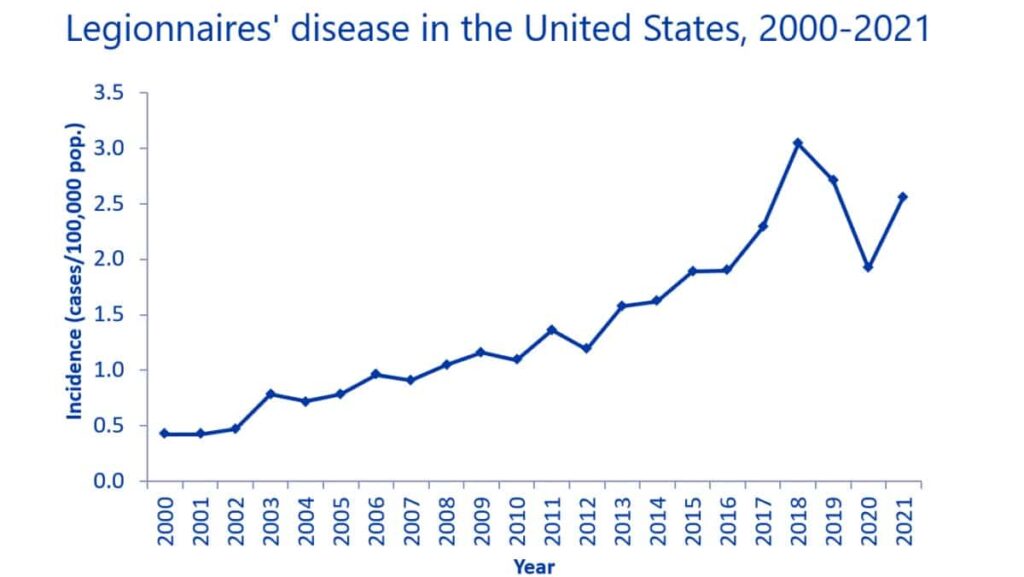
Source: Centers for Disease Control and Prevention (CDC). Legionnaires’ disease in the United States, 2000–2021.
Why Legionella Monitoring Matters in Real Systems
In most building water systems, the issue is not whether Legionella bacteria are present. It is how quickly conditions allow legionella growth to increase to hazardous levels.
Warm temperatures, low disinfectant residual, and inconsistent water flow create the perfect environment for legionella species to multiply. This is especially true in cooling towers, evaporative condensers, and domestic hot water systems.
When Legionella is not controlled, it can lead to legionnaires disease, a severe form of pneumonia that presents a serious public health risk. In real cases, contaminated cooling towers are often the source of outbreaks.
This is why routine monitoring, not just periodic testing, is critical.
What Is a Legionella Monitoring Program
A Legionella monitoring program is a structured approach to monitoring water quality, identifying hazardous conditions, and applying control measures to prevent legionella growth.
A complete program typically includes:
- Routine monitoring of water quality parameters
- Legionella testing and analysis of water samples
- Identification of high risk areas within the building water system
- Defined control limits for disinfectant levels and temperature
- Corrective actions when test results exceed thresholds
This is not a one time setup. It is a continuous process tied directly to water management programs.
Where Legionella Growth Occurs in Building Water Systems
Legionella growth does not occur evenly throughout a system. It concentrates in areas where conditions support bacterial growth.
Cooling Towers and Evaporative Systems
Cooling towers are one of the highest risk components in building water systems. Warm temperatures, constant air exposure, and organic matter create ideal conditions for legionella bacteria.
This is why controlling bacteria in cooling towers is critical to system performance and public health.
Hot Water Systems
Hot water systems often operate within the temperature range that supports legionella growth. If water heaters are not maintained at proper temperatures, or if water flow is inconsistent, growth can accelerate.
Cold Water Systems and Low Flow Areas
Cold water systems can also support legionella growth when water becomes stagnant. Dead legs, low use fixtures, and oversized piping systems create standing water conditions.
Plumbing Systems and Distal Points
The entire building water system must be considered. Legionella contamination often occurs at distal points such as faucets and showers where disinfectant residual is lowest.
Key Conditions That Support Legionella Growth
Understanding what drives legionella growth is the foundation of effective monitoring.
| Condition | Impact on Legionella Growth |
|---|---|
| Warm temperatures | Accelerates bacterial growth |
| Stagnant water | Allows bacteria to multiply |
| Low disinfectant residual | Reduces control effectiveness |
| Organic matter | Provides nutrients for growth |
| Poor water flow | Creates uneven conditions |
These conditions often exist simultaneously in large building water systems.
Legionella Monitoring vs Legionella Testing
Legionella monitoring and legionella testing are not the same thing, and confusing the two leads to poor programs.
- Legionella testing involves collecting water samples and analyzing for legionella bacteria
- Legionella monitoring involves tracking system conditions that support legionella growth
Effective programs combine both approaches.
For example, facilities that rely only on testing often miss early indicators. By the time legionella concentration is high enough to show up in colony forming units, the system has already been out of control.
Common Test Methods Used in Legionella Monitoring
There are several test methods used to detect Legionella bacteria.
Culture Testing
Culture testing is considered the traditional method. It measures colony forming units and provides quantitative data on legionella concentration.
PCR Testing
Quantitative polymerase chain reaction provides faster results by detecting genetic material. It is often used for rapid screening.
Field Indicators
Operators also monitor indirect indicators such as:
- Disinfectant residual levels
- Water temperature
- Flow rates
These indicators help identify areas where legionella growth is likely to occur.
For a deeper look at detection methods, see how Legionella detection methods are applied in building systems.
Role of Water Management Programs
Legionella monitoring is part of a broader water management program. Standards such as ASHRAE 188 and guidance from organizations like the American Industrial Hygiene Association emphasize a systematic approach.
A water management program includes:
- System mapping and identifying areas of risk
- Monitoring water quality and system conditions
- Establishing control limits for key parameters
- Implementing corrective actions
Without a structured management plan, monitoring alone is not effective.
Control Measures for Legionella
Monitoring only works if it is paired with effective control measures.
Disinfection
Maintaining a disinfectant residual is critical. Chlorine, chlorine dioxide, and other disinfectants are used to control bacteria in water systems.
Understanding how disinfectants behave is key. For example, chlorine effectiveness is highly dependent on pH, as discussed in chlorine and pH control.
Temperature Control
Temperature is one of the most effective control strategies. Maintaining hot water above recommended thresholds and keeping cold water below growth ranges helps limit legionella growth.
System Flushing and Flow Management
Regular flushing reduces stagnant water and improves disinfectant distribution.
Mechanical and Engineering Controls
Engineering controls include proper system design, eliminating dead legs, and ensuring consistent water flow throughout the building.
Monitoring Frequency and Routine Practices
Routine monitoring is what separates effective programs from reactive ones.
Facilities should:
- Collect water samples on a defined schedule
- Monitor disinfectant levels daily or continuously
- Track temperature at key locations
- Review trends over time
Routine monitoring helps identify issues before they become hazardous conditions.
Interpreting Test Results and Taking Action
Test results must be tied to action. A number alone does not improve safety.
Operators should:
- Compare results to established control limits
- Identify areas with increased risk
- Adjust control strategies based on data
In many cases, test results are only useful when combined with system knowledge.
For example, a spike in legionella concentration in one location often indicates a localized issue such as low flow or poor disinfection.
Risk Management and Compliance
Building owners and facility managers are responsible for maintaining safe water systems. Legionella monitoring programs are a key part of risk management and regulatory compliance.
This includes:
- Maintaining documentation of monitoring and testing
- Demonstrating compliance with standards and guidelines
- Responding to hazardous conditions
Failure to maintain proper programs can result in legal exposure, as seen in cases involving Legionella lawsuits.
Common Mistakes in Legionella Monitoring Programs
Even well intentioned programs can fail if they miss key elements.
Common issues include:
- Over-reliance on testing without monitoring system conditions
- Infrequent sampling that misses changes in water quality
- Lack of defined control limits
- Failure to address stagnant water areas
These mistakes lead to inconsistent control of legionella growth.
Building a More Effective Monitoring Program
An effective legionella monitoring program focuses on the system as a whole.
Key steps include:
- Mapping the entire building water system
- Identifying high risk areas such as cooling towers and hot water systems
- Implementing continuous monitoring of key parameters
- Integrating monitoring with treatment and control strategies
Facilities that take this approach are more likely to maintain stable conditions and reduce risk.
Frequently Asked Questions
What is Legionella monitoring
Legionella monitoring is the process of tracking system conditions and testing water to control legionella bacteria in building water systems.
How often should Legionella testing be performed
Frequency depends on system risk, but routine testing is required as part of a water management program.
What systems are most at risk for Legionella growth
Cooling towers, hot water systems, and areas with stagnant water present the highest risk.
What is the difference between monitoring and testing
Monitoring tracks system conditions, while testing measures the presence of legionella bacteria.
Why is Legionella control important
It protects public health and prevents legionnaires disease in building occupants.
Maintain Control of Legionella in Your Water Systems
Legionella monitoring is not just a compliance exercise. It is a practical tool for maintaining control over building water systems and reducing risk.
Facilities that combine monitoring, testing, and control measures are better equipped to manage legionella growth and maintain safe conditions.
If your facility is evaluating its monitoring program or dealing with inconsistent results, contact one of our experts to review your system and identify where risk is actually coming from.
