
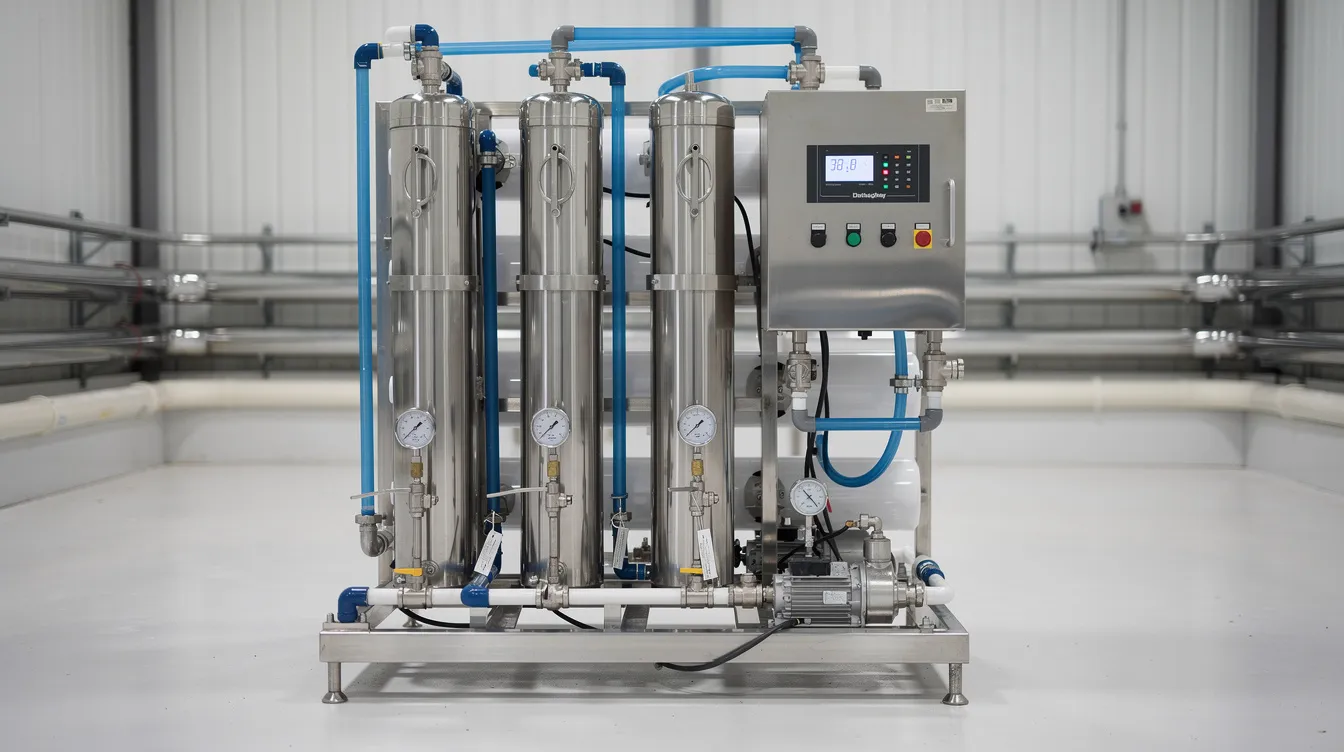
A commercial reverse osmosis system is a high-pressure water purification process designed to remove up to 99% of dissolved salts, minerals, and other contaminants. It works by forcing water through a semi-permeable membrane. This technology provides businesses with safe, dependable water essential for daily operations across various industries.
Key Takeaways
- Commercial reverse osmosis systems are versatile and customizable to fit diverse industrial water purification needs.
- Proper system selection and maintenance are critical to maximizing lifespan and performance.
- These systems contribute to sustainability by reducing plastic waste and lowering operational costs.
- Integration with existing water treatment infrastructure enhances overall system efficiency and reliability.
How a Commercial Reverse Osmosis System Works
The commercial reverse osmosis process unfolds in three key stages:
- Pre-filtration: This initial phase removes sediment and chlorine using a sediment filter and other components to protect the delicate RO membrane from damage.
- High-pressure pumping: Forces water through the reverse osmosis membrane at pressures ranging from 50 to 1000 psi. The membrane then separates pure water from impurities, including dissolved solids and other contaminants, achieving up to 99.8% removal of ionic salt minerals.
- Post-filtration and storage: The purified water undergoes polishing to ensure optimal quality before storage, providing a consistent supply for commercial applications.
Systems may use single-pass or double-pass configurations, where double-pass provides enhanced purity by running water through two membranes sequentially.
Benefits of a Commercial Reverse Osmosis System
Implementing a commercial reverse osmosis system offers numerous advantages:
- Improved product quality through consistent high purity water, essential for manufacturing and food service.
- Cost savings by reducing reliance on bottled water and lowering maintenance expenses related to scaling and corrosion. In boilers used for power generation, purified water also helps prevent lime scale and lowers the risk that impurities such as lead contribute to costly repairs.
- Extended equipment lifespan by preventing calcium buildup and other impurities from damaging machinery.
- Environmental benefits through minimizing plastic waste and promoting sustainable water treatment practices.
- Safe, dependable water supply that supports daily operations and compliance with health standards.
Where Commercial Reverse Osmosis Systems Are Used
Commercial reverse osmosis systems serve a variety of industries:
| Industry | Use Case |
|---|---|
| Restaurants & cafes | Enhance beverage taste and consistency |
| Hospitals & labs | Provide sterile, contaminant-free water |
| Manufacturing | Maintain product integrity and equipment longevity |
| Hotels & resorts | Ensure safe drinking water for guests |
| Ice production | Support profitable water-based businesses |
Types of Commercial Reverse Osmosis Systems
Different models cater to specific needs:
- Standard Commercial RO: Ideal for general purification requirements in commercial applications.
- High-Pressure Commercial RO: Suited for car washes and industrial processes needing higher pressure and flow.
- Large Capacity Commercial RO: Designed for hotels, hospitals, and factories requiring significant water volumes.
- Customized Commercial RO: Engineered to meet specific site requirements and water treatment goals.
- Light Commercial RO: Best for smaller institutions like schools or offices with lower water demands, including low pressure operation. For example, the MRO-4-LP Series offers 3,600–16,200 GPD.
Choosing the Right Commercial Reverse Osmosis System
Selecting the optimal system involves evaluating several factors:
| Factor | What to Consider |
|---|---|
| Water quality | Test for total dissolved solids (TDS), pH, hardness, and other contaminants |
| Capacity/flow rate | Calculate daily usage including peak demand periods, and match typical flow rates from 300 to 50,000 gallons per day to your demand profile |
| Budget | Assess initial price, ongoing maintenance, and energy costs |
| Space availability | Ensure system fits within site constraints, considering space saving design |
| Maintenance | Understand filter replacement intervals and cleaning requirements |
| Certifications | Verify compliance with regulatory standards |
Tip: Accurately measure peak usage periods to determine the necessary flow rate and avoid downtime. Smaller reverse osmosis systems deliver up to 300 gallons per day, while larger industrial reverse osmosis systems can scale much higher. For example, the MRO-8H Series offers 36,000-432,000 gallons per day capacity.
Performance Metrics for Commercial RO Systems
Key performance indicators include:
- Membrane quality, which directly impacts filtration efficiency and recovery rate.
- Number of filtration stages, ranging from single to three-stage systems, affecting water purity.
- Recovery rate, the ratio of purified water produced to feedwater used, influencing operational costs.
- Concentration factor, a design consideration for handling impurities and ensuring durability.
Maintaining Commercial Reverse Osmosis Systems
To ensure optimal performance and reliability:
- Follow manufacturer guidelines for operation and maintenance.
- Conduct periodic membrane cleanings to extend membrane life.
- Monitor system performance regularly, including pressure and water quality, with remote monitoring and data analysis included in the maintenance program and available online.
- Replace filters according to schedule to prevent particles and calcium buildup.
- Implement smart maintenance practices to reduce electricity consumption and prevent downtime.
Cost of a Commercial Reverse Osmosis System
Investment considerations include:
- Initial purchase price, which varies by system size and features, and some units are built for durability and shipped fully assembled for easier installation.
- Operating costs comprising energy consumption, routine maintenance, and filter replacements.
- Long-term savings by reducing the need for bottled water outsourcing, minimizing equipment repair costs, and improving return on investment for a business that depends on reliable purified water.
- Lower risk and cost associated with maintaining an on-site water treatment machine versus external supply. Contact the supplier for pricing or system selection details.
Optimizing Water Treatment Solutions
Commercial reverse osmosis systems are engineered to provide high purity water essential for a wide range of industrial applications. Their space saving design, reliability, and ability to remove dissolved solids, calcium, and other contaminants make them ideal for customers seeking optimal performance and cost-effective water treatment solutions. By choosing the right model and maintaining it properly, businesses can enjoy safe, sustainable water supply that supports their operational needs with peace of mind.
Frequently Asked Questions (FAQs)
What are reverse osmosis RO systems used for in commercial settings?
Reverse osmosis RO systems are widely used to provide high-purity water for industries such as food and beverage, pharmaceuticals, horticulture, power generation, semiconductor manufacturing, and municipal wastewater treatment. They help remove contaminants and improve product quality and equipment longevity.
How often should commercial RO systems be maintained?
Commercial RO systems require regular maintenance including periodic membrane cleaning, filter replacements, and system audits to adjust for changing feedwater chemistry. Remote monitoring and data analysis can help optimize maintenance schedules and ensure efficient operation.
What is the typical capacity range for commercial reverse osmosis systems?
Commercial RO systems vary widely in capacity, typically delivering from 300 gallons per day for smaller units up to 50,000 gallons per day or more for larger industrial models. For example, the MRO-8H Series can provide between 36,000 and 432,000 gallons per day.
How does seamless integration benefit commercial RO system installation?
Seamless integration allows commercial RO systems to fit easily into existing water treatment setups, optimizing space and operational efficiency. This reduces installation time and helps businesses maintain continuous water supply without disruption.
How long does it take to get a commercial reverse osmosis system in stock and delivered?
Depending on the model and customization, commercial RO systems are often available from stock and can be delivered within a matter of weeks. This quick availability supports businesses committed to minimizing downtime and ensuring a reliable water supply.
