
Understanding cooling tower types is essential for selecting, operating, and maintaining the right cooling system for industrial facilities, power plants, and commercial HVAC systems. Different types of cooling towers are designed around how air moves through the tower, how water flows across the fill media, and how heat transfer occurs through evaporative cooling.
For operators, the choice between natural draft cooling towers, mechanical draft cooling towers, wet cooling towers, or hybrid cooling towers directly impacts cooling demand, energy use, water consumption, and water quality management.
This guide breaks down the main types of cooling towers, how they work, where they are used, and what to consider when selecting or operating a cooling tower system.
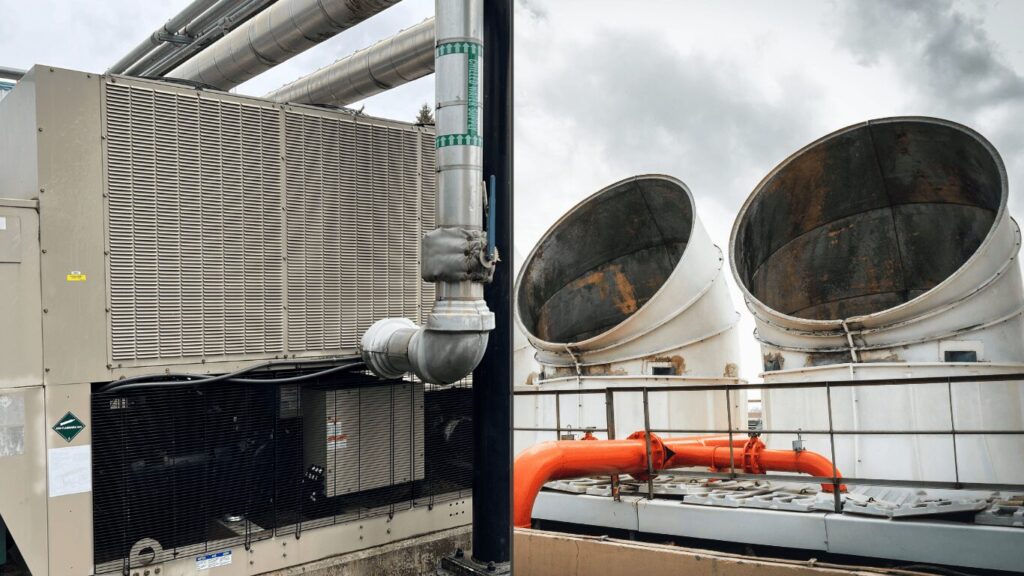
How Cooling Towers Work (Quick Overview)
Cooling towers remove unwanted heat from process water or HVAC loops by using evaporative cooling. Hot water from the process enters the tower and is distributed over fill media, increasing surface area. As ambient air flows through the tower, a portion of the water evaporates, removing heat and lowering the temperature of the remaining water.
Key concepts:
- Evaporative cooling drives heat removal
- Wet bulb temperature limits achievable cooling
- Air movement (natural convection or fans) determines performance
- Water flows over fill material to maximize contact with air
The cooled water collects in the cold water basin and is recirculated to the process.
Main Cooling Tower Types
Cooling tower types are generally classified by two factors:
- Air movement (natural draft vs mechanical draft)
- Water-to-air contact design (counterflow vs crossflow)
1) Natural Draft Cooling Towers
Natural draft cooling towers rely on natural convection—warm, moist air rises and draws in cooler ambient air without fans. These are typically large cooling towers used in power plants and nuclear power plants.
- Often designed as a hyperbolic cooling tower
- No mechanical fans required
- Suitable for large-scale heat loads
Advantages:
- Low operating energy (no fans)
- Reliable for large continuous loads
Limitations:
- High capital cost
- Large footprint
- Less flexible for variable water flow
2) Mechanical Draft Cooling Towers
Mechanical draft cooling towers use fans to move air through the tower. These are the most common cooling tower types in industrial and commercial applications.
There are two main subtypes:
Forced Draft Cooling Towers
In forced draft cooling towers, centrifugal fans push air into the tower.
- Air is forced through the tower from the base
- Good control of airflow
Advantages:
- Easy maintenance access
- Stable air movement control
Limitations:
- Recirculation of warm air possible
- Lower efficiency compared to induced draft
Induced Draft Cooling Towers
An induced draft cooling tower pulls air through the tower using fans located at the top.
- Creates uniform air flow across fill media
- Reduces recirculation of hot air
Advantages:
- Higher heat transfer efficiency
- More consistent cooling performance
Limitations:
- Fan maintenance at elevation
Most cooling towers used in HVAC systems and industrial cooling systems are induced draft towers.
Water Flow Design: Counterflow vs Crossflow
Counterflow Cooling Towers
In counterflow towers, air flows upward while water flows downward over the fill media.
- High heat transfer efficiency
- Compact design
- Often used in counterflow cooling towers for industrial applications
Crossflow Cooling Towers
In crossflow cooling towers, air flows horizontally across falling water.
- Simpler design
- Lower fan energy requirements
- Often used in commercial HVAC systems
Other Cooling Tower Configurations
Wet Cooling Towers
Wet cooling towers use evaporative cooling directly and are the most common type in industrial cooling applications.
Dry Cooling Towers
Dry cooling towers use air-cooled heat exchangers without evaporation. These are used where water usage must be minimized.
Hybrid Cooling Towers
Hybrid cooling towers combine wet and dry operation to balance water usage and energy efficiency.
Closed Circuit Cooling Towers
Closed circuit cooling towers use a heat exchanger coil to isolate process water from the tower water, improving water quality control.
Comparison of Cooling Tower Types
| Type | Air Movement | Water Flow | Typical Use | Key Advantage |
|---|---|---|---|---|
| Natural Draft | Natural convection | Counterflow | Power plants | Low energy use |
| Induced Draft | Fan (top) | Counterflow | Industrial systems | High efficiency |
| Forced Draft | Fan (bottom) | Crossflow | Commercial systems | Simpler maintenance |
| Closed Circuit | Fan + coil | Indirect | Sensitive processes | Protects process water |
| Hybrid | Mixed | Mixed | Water-limited sites | Balances water and energy |
Key Components in Cooling Tower Design
Regardless of type, most cooling towers share common components:
- Spray nozzles / pressurized spray nozzles to distribute hot water
- Fill media / tower fill to increase surface area
- Fans (for mechanical draft towers)
- Cold water basin for collection
- Drift eliminators to control water droplets
The design of these components directly affects heat transfer, air flows, and overall cooling capacity.
Applications Across Industries
Cooling towers are used across many industries where heat must be removed:
- Power plants and nuclear power plants
- Industrial processes
- HVAC and air conditioning systems
- Commercial HVAC systems
- Manufacturing and data centers
Cooling towers absorb heat from systems and transfer it to the atmosphere through evaporative cooling.
Operational Considerations
Choosing between different types of cooling towers depends on:
- Cooling demand and heat load
- Available space and footprint
- Ambient air conditions
- Wet bulb temperature
- Water availability and make up water requirements
Operators must also manage:
- Water quality to prevent fouling and scaling
- Air flow and fan performance
- Variable water flow conditions
Cooling Tower Water Treatment Matters
Regardless of cooling tower type, water quality plays a critical role in performance. Poor water quality can lead to:
- Fouling on heat exchangers
- Reduced heat transfer
- Biological growth
- Increased maintenance and downtime
A proper cooling tower water treatment program ensures reliable operation and protects system components.
Learn more about our cooling tower water treatment services.
Maintain Reliable Cooling Tower Performance
Understanding cooling tower types is the first step in selecting and operating the right system. But long-term performance depends on how well the system is maintained, monitored, and treated.
Aquatrol works with facility teams to evaluate cooling tower systems, improve efficiency, and maintain water quality across all cooling tower types.
If your facility needs support with cooling tower performance or system evaluation, talk to us today to review your cooling tower system.
